
 Dhaval G.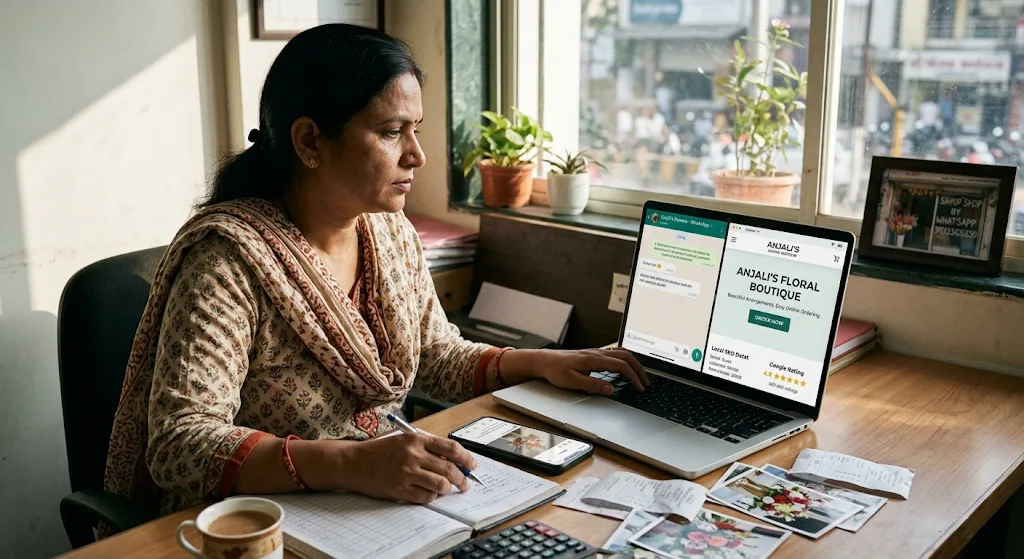
A florist we know in Surat had been running her shop for eleven years on pure word of mouth, a WhatsApp contact number painted on her shop window, and an Instagram page she updated when she remembered to. Business was fine until a competitor opened two streets away with a proper website, online ordering, and a Google Business Profile. Within eight months, her walk-in traffic had dropped 30%. She hadn't changed anything. Her competitor had simply made themselves easier to find. When she finally came to us and we set up her website and Google presence, the results weren't gradual the phone started ringing differently within three weeks.
If you're asking "does my small business need a website," you're asking the right question and you're not alone. Despite 29% of small businesses still lacking an online presence, the evidence for why every business needs a website in 2026 has never been stronger or more data-backed. This guide covers exactly what you're losing without one, what a basic website actually gives you, and why social media is not the substitute most business owners think it is.
The Short Answer: Yes, And the Data Is Not Close
Let's not bury the lead. Every credible study conducted in the last five years points the same direction:
- Roughly 99% of consumers use the internet to discover local businesses and 21% conduct online searches every day to find local options
- Businesses with websites are 2.8x more likely to grow revenues, according to a Google and Deloitte study of over 4,500 small businesses
- Small businesses without websites lose over $70,000 annually in potential revenue, according to NFIB survey data
- 75% of people judge a business's credibility by its website design and 88% will not return after a bad experience
- Small businesses with websites grow revenue 40% faster than those without one
These aren't soft suggestions. They're documented, measurable business outcomes across tens of thousands of companies. The question isn't really whether you need a website it's how much the absence of one is currently costing you.
What Exactly Are You Losing Without a Website Right Now?
Most small business owners without a website don't feel the loss acutely because the customers they're losing are invisible. You can't see the people who searched for your service, didn't find you, and booked your competitor instead. But those people exist. Every single day.
You Are Invisible to 99% of Online Searchers
Approximately 70% of website traffic originates from Google. Implementing strong SEO strategies is critical for any small business to enhance visibility and attract visitors. If you don't have a website, Google has nothing to index, nothing to rank, and nothing to show the person searching for exactly what you offer right now.
Think about your own behaviour. When was the last time you chose a restaurant, a plumber, a salon, or a service provider without first checking them out online? Your customers behave the same way. 81% of consumers research businesses online before using their services. Without a website, you fail that check before the conversation even starts.
You're Handing Customers Directly to Competitors
30% of consumers won't even consider a business without a website. That's not 30% who prefer businesses with websites. That's 30% who have made an automatic decision to eliminate you from their options without calling, without asking around, without giving you any chance to make your case. In any market where your competitors have websites and you don't, you're operating at a structural disadvantage before a single conversation happens.
You're Losing Credibility Before You Even Speak
84% of consumers say a business's website is more credible than its social media presence. When someone hears about your business through a friend, a referral, a flyer the first thing they do is look you up. 60% of consumers dismiss a business if they can't find information about them online.
No website doesn't just mean no traffic. It means the people who already heard about you warm leads, referrals, word-of-mouth are encountering a credibility gap at the moment they're most ready to act. That's the most expensive kind of lost business.
"But I Already Have Instagram and Facebook Isn't That Enough?"
This is the most common question we hear from small business owners. The answer is no and the reasons matter, because they're not about preference. They're about risk and ownership.
You Don't Own Your Social Media Audience
Your Instagram following, your Facebook page, your WhatsApp contacts none of them belong to you. They belong to the platforms. Instagram can reduce your reach overnight with an algorithm update. Facebook has done this repeatedly to business pages. Your account can be restricted, hacked, or suspended. When that happens, you have no recourse and no backup.
Your website is the only digital asset your business truly owns. Your domain, your content, your email list, your Google ranking all of it belongs to you and cannot be taken away by a platform policy change.
Social Media Does Not Rank on Google
87% of consumers discover local businesses through Google Search, and 86% use Google Maps. Social media profiles appear in Google results but they don't rank for the specific service searches that drive buying intent "best wedding photographer in Ahmedabad," "plumber near me open now," "affordable accountant for small business." Those searches require a website with proper SEO to capture. Social media captures people already looking for you. A website captures people who don't know you exist yet.
Social Media Is a Complement Not a Replacement
The most effective small businesses use social media to drive traffic and build community and their website to convert visitors into customers. Instagram shows someone your product. The website answers their questions, builds trust, and lets them book or buy. Removing the website from that equation is like running ads that lead to a disconnected phone number.
What a Small Business Website Actually Does For You: 9 Real Benefits
A website isn't just a digital brochure. When it's built correctly, it works as your best salesperson 24 hours a day, 365 days a year, without a salary or a sick day.
1. Customers Find You When They're Ready to Buy
At least 78% of location-based mobile searches lead to offline purchases. Someone searching "dentist near me" or "bakery open Sunday" is not browsing casually they are moments away from making a decision. A website with basic local SEO puts you in front of that person at the exact moment they're ready to act.
2. You Build Credibility Instantly
75% of consumers judge a business's credibility through its website design. A clean, professional website communicates that you take your business seriously. It's the digital equivalent of a well-maintained shop front it sets the expectation before the customer ever speaks to you.
3. You Generate Leads While You Sleep
A contact form, a booking system, an enquiry button these work around the clock. Customers in different time zones, or those who prefer to research at 11pm, can reach you without you doing anything. We've had clients who wake up to three new enquiries every morning simply because their website captures what their phone line misses.
4. You Control Your Own Story
On social media, your business appears in a feed alongside competitors, distractions, and algorithms you don't control. On your website, the only business the visitor sees is yours. You choose the messaging, the layout, the proof points, and the offer. It's the one place where you have complete editorial control over how your business is perceived.
5. You Rank on Google and Get Free Traffic Forever
Every well-written page on your website is a potential entry point from Google. A blog post answering a common customer question. A services page targeting a local search. An FAQ covering what your customers want to know. Once these pages rank, they bring in traffic indefinitely without paying for ads every month. Approximately 70% of all website traffic comes from Google search, and it costs nothing per click once you're ranked.
6. You Look Bigger Than You Are
A well-designed website can make a two-person operation look as professional and established as a large company. For small businesses competing with larger players, this levels the playing field in a way that nothing else can. Your site tells the story you want to tell not the story your lack of presence tells by default.
7. You Collect Email Addresses and Own Your Audience
A simple email capture form on your website offering a discount, a free guide, or a newsletter builds a list of interested customers that no algorithm can take from you. Email marketing consistently returns the highest ROI of any digital marketing channel, and it all starts with a website collecting addresses.
8. You Enable Online Selling at Zero Additional Rent
54% of Americans use mobile devices for online shopping, and that proportion is growing globally. Adding an online shop to your website isn't just for large retailers. A local bakery can take pre-orders. A tailor can sell gift vouchers. A consultant can sell downloadable guides. Your website can generate revenue from customers who will never physically visit your location.
9. Your Competitors Already Have One
Despite 29% of small businesses lacking an online presence, that figure has been declining year on year which means more and more of your direct competitors are establishing digital advantages while you wait. The top three local search positions capture 75% of all clicks on the first page of results. Every month without a website is another month those positions solidify in someone else's favour.
What Does a Small Business Website Actually Cost?
Cost is the most common reason small business owners delay building a website and the numbers are usually much lower than expected.
The Real Price Range in 2026
- DIY website builder (Wix, Squarespace): $13–$25/month, fully self-managed. Reasonable for a very basic online presence with no custom design
- Freelancer-built website: $500–$3,000 one-time, depending on complexity. More professional than a template, less comprehensive than an agency
- Professional agency website (like Alpha Bytes): $1,000–$8,000 depending on scope includes custom design, SEO setup, mobile optimization, and ongoing support
- Domain name: $12–$20/year
- Hosting: $5–$50/month depending on provider and plan
The Real Cost of NOT Having One
Small businesses without websites lose over $70,000 annually in potential revenue based on conservative modelling of missed leads and lost customers across industries. Even if that number is off by half for your specific business, a $35,000 annual loss makes a $2,000 website investment look like the most obvious financial decision you'll make this year.
We built a website for a local accounting firm last year. Within 90 days, they had three new clients sourced entirely through Google two of whom signed annual contracts worth significantly more than the total cost of the website. That's not an exceptional result. That's a standard outcome when a business that was invisible online becomes findable. The website paid for itself before the third month was over.
What Makes a Good Small Business Website? The Non-Negotiables
Not all websites are created equal. A website that loads slowly, isn't mobile-friendly, or buries your contact information isn't just unhelpful it actively damages your reputation. Here's what every small business website must have.
Mobile-First Design
Over 54% of web traffic comes from mobile devices, and 88% of consumers who search for local businesses on a smartphone visit or call within 24 hours. If your website doesn't work perfectly on a phone fast, clear, with easy-to-tap buttons you are losing those visitors the moment they arrive.
Clear Contact Information on Every Page
44% of website visitors leave if there is no contact information visible. Your phone number, email, address (if relevant), and hours of operation should appear in the header or footer of every page not buried in a separate "Contact Us" section that requires three clicks to find.
A Clear Call to Action
70% of small business websites lack a clear call to action on the homepage. Every page of your website should answer the question: "What do I want the visitor to do next?" Book an appointment. Request a quote. Call us. Shop now. Without a clear next step, visitors leave without converting even when they're genuinely interested.
Fast Loading Speed
Of mobile users, 53% abandon a website that takes more than 3 seconds to load. Beyond user experience, page speed is a confirmed Google ranking factor meaning a slow website doesn't just frustrate visitors, it actively suppresses your visibility in search results. Every second of load time you cut directly improves both your rankings and your conversion rate.
Basic SEO From Day One
A website that no one can find is a website that does nothing. Basic SEO the right page titles, correct heading structure, location-specific keywords, a Google Business Profile connected to your site is what turns a digital brochure into a lead-generating machine. This doesn't require ongoing monthly retainers. A properly built website with good SEO foundations generates traffic passively once it's set up.
Key Takeaways
Everything you need to act on, in one place:
- 99% of consumers search online before making a purchase or visiting a business without a website, you are invisible to virtually all of them
- Businesses with websites are 2.8x more likely to grow revenues and grow 40% faster than those without
- 30% of consumers won't consider a business that doesn't have a website this applies before they ever speak to you
- Social media is not a substitute it doesn't rank on Google, you don't own the audience, and 84% of consumers trust a website more than a social media profile
- Small businesses without websites lose an estimated $70,000+ annually in missed revenue
- A basic but well-built business website costs $1,500–$5,000 a fraction of the annual revenue it generates once it's ranking
- The non-negotiables: mobile-first design, visible contact info, a clear call to action, fast load speed, and basic SEO from day one