
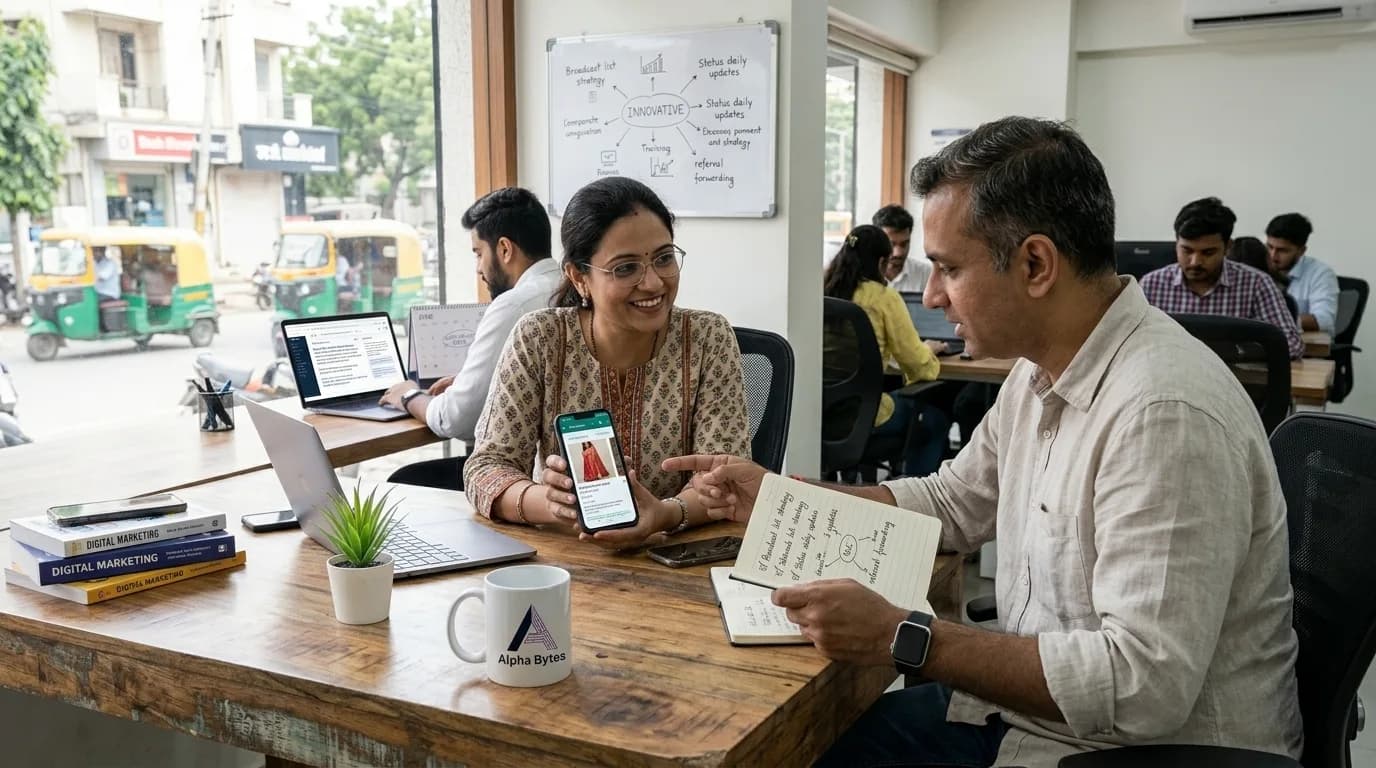
A tailoring shop owner in Rajkot was spending ₹12,000 a month on newspaper ads and getting maybe three or four new enquiries from them. Her competitor across town same prices, similar work had a WhatsApp Business number that customers forwarded to their friends with messages like "save this number, she's excellent." She had 340 customers on a broadcast list. She sent a photo of a new fabric every Tuesday morning. Her order book was full three weeks ahead. She spent nothing on advertising. When the tailoring shop owner finally asked her how she did it, the answer was simple: "I send one good photo a week and I always reply within the hour." That's it. A WhatsApp broadcast list, one weekly update, and fast replies. No marketing budget. No agency. No complicated strategy.
This is what WhatsApp Business marketing looks like in practice for small businesses in India in 2026 not complicated, not expensive, and available to any business that uses WhatsApp, which is most of them. India accounts for the largest share of cumulative WhatsApp Business app downloads globally, crossing 480 million by 2025, with 78% of Indian small businesses already using WhatsApp for customer communication and 65% reporting that their sales increased after they adopted it. The businesses in that 35% who haven't seen results are not using a bad tool they're using a good tool badly. This guide covers exactly how to use it well. Businessideas
Why WhatsApp Is the Most Powerful Marketing Channel Available to Indian Small Businesses
Every business owner has heard that they should be on Instagram, that they should run Google ads, that they should build an email list. These are legitimate channels. But none of them reach customers the way WhatsApp does in India and the data is decisive on this point.
The Numbers That Make WhatsApp Unmissable
WhatsApp messages achieve 98% open rates in India, against 22% for email and roughly 5–10% for Instagram organic posts. Read that again: 98% of WhatsApp messages are opened. 49% of users interact with brands on WhatsApp, and 46% of marketers are increasing their investment in WhatsApp in 2026 to capture high-intent users. BusinessideasSprout Social
WhatsApp sits in the same inbox where people talk to their mother and their best friend. A business message that lands there is read differently from an Instagram ad that interrupts a scroll. This is the advantage no other marketing channel offers: your message arrives in the most trusted, most frequently checked space on your customer's phone not in a separate app they open occasionally, not in an email inbox they clear once a week, but in the place where they have their most important daily conversations.
What This Means for Your Business
If your business currently relies on Instagram posts that 10% of your followers see, email newsletters with 20% open rates, or SMS blasts that most people ignore switching even a portion of that effort to WhatsApp Business delivers dramatically better reach per message to the same audience. The customers who gave you their phone number have already opted into a relationship with your business. WhatsApp is how you maintain that relationship without competing against an algorithm.
WhatsApp Business vs Regular WhatsApp: What's Actually Different
Most small business owners use regular WhatsApp for business. They send photos, answer questions, confirm orders all on their personal number. This works to a point. But it has four specific limitations that WhatsApp Business solves.
What WhatsApp Business Adds
- Business profile with complete information — your business name, category, address, website, hours, and description all visible to customers before they start chatting. This alone builds more trust than a personal number with no profile context.
- Product and service catalogue — browse and share your products or services directly inside the WhatsApp chat, without the customer needing to visit your website or Instagram. A customer who asks "what sarees do you have?" can be shown the catalogue in 10 seconds.
- Quick replies — pre-saved responses to your most common messages. "What are your timings?" gets a quick reply with a single button press. "How do I place an order?" gets a step-by-step response without you typing it every time.
- Labels and organisation — tag conversations as New Customer, Order Placed, Payment Pending, Follow-Up Needed. Your WhatsApp becomes a simple CRM, not a chaotic inbox.
- Away messages and greeting messages — automatically reply to messages received when you're unavailable, and send a welcome message to every first-time sender. No customer's first message goes unanswered, even at 11pm.
- Business statistics — see how many messages were sent, delivered, read, and received. For the first time, your WhatsApp activity has data behind it.
When to Move to WhatsApp Business API
The WhatsApp Business app (free, for single users) covers most small business needs. The WhatsApp Business API accessed through Indian Business Solution Providers like Interakt, Wati, or AiSensy adds the ability to have multiple team members managing one WhatsApp number, send automated message sequences triggered by specific events, integrate WhatsApp with your CRM or booking system, and run Click-to-WhatsApp ad campaigns. The API is the foundation for the kind of AI automation systems that keep businesses running without the owner being available 24/7. For businesses receiving more than 50 WhatsApp enquiries per day or wanting to automate follow-up sequences, the API is worth the investment.
Setting Up WhatsApp Business Properly: The Foundation Most Businesses Skip
Most small businesses download WhatsApp Business, put their business name in, and start messaging without doing the setup that makes the app a proper marketing channel. These ten minutes of setup work determine how professional and trustworthy your business looks to every customer who messages you.
Your Business Profile Checklist
- Business name: Use your actual business name, not a nickname or abbreviation your regular customers use. New customers will search for your official name.
- Category: Choose the most specific category available. "Local Business" is not as useful as "Clothing Store" or "Healthcare Provider" or "Web Design Agency."
- Description: Write 2–3 sentences that explain what you do, who you serve, and what makes you different. This is the first thing a new customer reads.
- Address: Include your full address if customers visit you in person. This enables Google Maps integration.
- Business hours: List your actual hours including whether you respond to WhatsApp messages outside those hours (most businesses respond during business hours but messages arrive 24/7).
- Website: Link to your actual website. If you don't have one yet, this is the moment to recognize that every WhatsApp contact who wants to know more about you will look at whatever link is here making having a proper website directly relevant to your WhatsApp credibility.
- Profile photo: Your business logo, clearly visible at small size. Not a photo of you, not a collage, not text your logo.
Your Catalogue Setup
If your business sells physical products, your WhatsApp catalogue is the most underused feature in the app. A well-organized catalogue with clear product photos, accurate descriptions, and prices listed removes the most common friction in WhatsApp sales: the back-and-forth of "what do you have" followed by one product photo at a time.
Set up your catalogue with your best-selling 10-20 products or services. Each item needs: a clear photo (not the same photo you use for Instagram shoot specifically for the small screen and circular catalogue thumbnail), a clear name, a one-sentence description, and a price if you're comfortable listing it publicly. Businesses that list prices in their catalogue consistently report fewer time-wasting enquiries and more enquiries from serious buyers.
The 4 WhatsApp Marketing Strategies That Actually Generate Customers
Strategy 1 — The Weekly Status Update
WhatsApp Status is your free daily billboard to everyone who has your number saved. Unlike Instagram Stories where the algorithm controls who sees your content WhatsApp Status is shown to every contact who has your number saved, in order of your most recent activity. Use your WhatsApp Status daily to showcase your work. Not daily product pitches a photo of a completed job, a behind-the-scenes moment, a useful tip for your customer base, a customer's reaction to receiving their order. One Status per day. Visible to 100% of your saved contacts. Costs nothing. GrowEasy
The business that posts one WhatsApp Status per day maintains top-of-mind awareness with every customer who has ever saved their number without any of those customers needing to follow an account, check an app, or be served by an algorithm.
Strategy 2 — The Broadcast List System
A WhatsApp broadcast sends one message to multiple contacts simultaneously. Each recipient receives it as a personal message they see it in their individual chat with you, not in a group where everyone else is visible. Replies come back to you privately.
This is the most direct, personal-feeling mass communication available to any business. The critical requirement: contacts must have your number saved in their phone to receive broadcasts. This means your broadcast list is built from genuine customers and warm leads people who chose to have a relationship with your business not bought lists.
Build your opt-in list through website buttons, lead forms, Meta Click-to-WhatsApp ads, and in-person QR codes. A QR code at your cash counter, check-out desk, reception area, or on your packaging "Save this number and join our WhatsApp list for weekly offers" builds your broadcast list from every physical customer interaction.
Strategy 3 — The Referral-Through-WhatsApp System
The most common way a new customer discovers a small business in India is not Google it is a friend forwarding a message. A product photo with a price and your WhatsApp number. A screenshot of a good experience. A message that says "contact this person, she's excellent." WhatsApp's forward button is the most powerful organic referral mechanism in any marketing platform in the country.
Building this into your process means making your messages worth forwarding. A photo of your work with a clear caption. A useful tip that a customer would share because it helps their contacts. An offer that specifically says "forward to a friend who might need this." Every forward is a warm referral someone the original customer trusts enough to personally recommend you to.
This referral loop is the same dynamic we see in the online reputation data: personal recommendations carry far more weight than any advertisement, and WhatsApp makes personal recommendations as easy as pressing one button.
Strategy 4 — The Conversational Follow-Up Sequence
WhatsApp messages are opened almost immediately, often within minutes or even seconds. This means a follow-up message on WhatsApp reaches customers at a moment of maximum attention unlike an email that sits in an inbox for three days or an SMS that gets ignored.
A simple follow-up sequence for any service business:
- Day 1 after service: "Hi [Name], thank you for visiting us today. Hope everything was exactly what you needed. Feel free to WhatsApp us if you have any questions."
- Day 7: "Hi [Name], checking in to see how you're getting on with [service/product]. If you need anything at all, we're here."
- Day 14: "Hi [Name], if you had a good experience with us, we'd genuinely appreciate a Google review it makes a real difference for a small business. Here's the direct link: [link]."
Three messages. Personalised. Sent over two weeks. Produces significantly higher review rates, repeat visit rates, and referrals than businesses that never follow up without requiring any significant time investment once the templates are saved as Quick Replies.
WhatsApp Automation: Making It Work Without You
The limitation of manual WhatsApp marketing is time. You can't personally respond to every message within minutes, 24 hours a day, without becoming your own after-hours customer service team. WhatsApp automation through the Business API removes this constraint by handling the predictable, repeatable interactions without any human involvement.
What WhatsApp Automation Handles
- Instant greeting messages to every new sender, 24 hours a day
- Automated FAQ responses triggered by specific keywords if a customer sends "price" or "timing" or "booking," they receive the relevant answer immediately
- Appointment booking flows that check availability and confirm bookings through a WhatsApp conversation, without you being involved
- Order status updates triggered when an order is packed, shipped, or delivered the customer receives a WhatsApp notification automatically
- Review request messages sent automatically 24-48 hours after a service is completed
- Re-engagement messages to customers who haven't ordered in 30 days
These automations use the same AI and workflow tools n8n, Make.com, WhatsApp Business API that power the AI agents and business automation systems we build for clients at Alpha Bytes. The WhatsApp channel is one component of a broader automation system connected to your booking tool, your CRM, and your website so information flows between them without manual data entry.
What Automation Should Not Replace
Automation handles the predictable. Genuine relationship conversations the customer who has a complaint, the long-term client who has a specific request, the potential customer evaluating whether to trust your business with an important job these require a human response. The businesses that use WhatsApp automation most effectively are the ones that set it up to handle the 70% of interactions that are routine, so their actual time goes to the 30% that genuinely needs them.
Common WhatsApp Business Mistakes That Cost Indian Small Businesses Customers
Mistake 1 — Sending Bulk Messages to Unsaved Numbers
Sending promotional messages to numbers who haven't saved your contact is the fastest way to get your WhatsApp Business account banned. WhatsApp India has significantly tightened its spam detection in 2026. Any contact who marks your message as spam even once contributes to an account quality score that can lead to a messaging restriction or permanent ban. Build your list from opted-in contacts only. Every contact on your broadcast list should have saved your number voluntarily.
Mistake 2 — Treating WhatsApp Like Email
Long, image-heavy messages with promotional text formatted like email newsletters perform poorly on WhatsApp. The channel is conversational it works best when messages feel personal, brief, and directed at one specific person even when they're going to many. One strong photo, one sentence, one clear call to action. Read your draft aloud before sending. If it sounds like an advertisement rather than something a friend would send, rewrite it.
Mistake 3 — Going Quiet Between Purchases
The most common WhatsApp marketing failure: a business that responds fast during the sales process and then goes silent until the customer needs something again. The customers who receive value between purchases a useful tip, a piece of useful information, an early heads-up about something new are the ones who think of that business first when the need arises again. Once a month between purchases. Something useful. Not a sales message. Just a reason to keep the relationship warm.
Mistake 4 — Not Connecting WhatsApp to Everything Else
Your WhatsApp number should appear on your Google Business Profile, your website's contact section, your Instagram bio, your business cards, your packaging, and your email signature. Most businesses have a WhatsApp number that customers can only reach if they already have it which means new customers who want to message you can't find the number. A clearly displayed WhatsApp link (wa.me/91XXXXXXXXXX) turns every digital touchpoint into a WhatsApp entry point.
How Alpha Bytes Helps Businesses Build WhatsApp Marketing Systems
We build the technical infrastructure that makes WhatsApp marketing scale WhatsApp Business API integration, automated message sequences triggered by bookings, orders, and service completions, CRM integration that ensures every WhatsApp conversation is logged and followed up, and website contact forms that route directly to WhatsApp instead of email.
For businesses that currently use WhatsApp manually and want to automate the predictable parts while preserving the personal feel the enquiry acknowledgements, the booking confirmations, the review requests this is precisely the type of system we design and build. If your website is currently sending enquiries to an email inbox that you check twice a day rather than directly to a WhatsApp conversation you respond to in minutes, fixing how your website handles enquiries is the starting point before WhatsApp automation adds full value.
Key Takeaways
- WhatsApp messages achieve 98% open rates in India higher than any other marketing channel available to small businesses Businessideas
- 78% of Indian small businesses already use WhatsApp for customer communication. The difference between those seeing results and those not is strategy, not the tool
- WhatsApp Business (free) adds business profile, catalogue, quick replies, labels, away messages, and statistics to regular WhatsApp setup takes 30 minutes and immediately improves professionalism
- The four strategies that generate customers: WhatsApp Status daily, broadcast lists to opted-in contacts, making messages worth forwarding, and a post-service follow-up sequence
- Automation (via WhatsApp Business API) handles the routine 70% of interactions instant greetings, FAQ responses, booking confirmations, review requests so your time goes to the conversations that genuinely need you
- The three rules for staying out of trouble: only message opted-in contacts, write conversationally not like email newsletters, and maintain value between purchases not just during them
Final Thoughts
For many Indian small businesses in 2026, WhatsApp isn't a substitute for a marketing strategy it is the marketing strategy. The businesses that understand this are not spending more on advertising. They are spending their time building a list of opted-in contacts, maintaining a weekly presence in those contacts' most-trusted inbox, and building a follow-up system that turns every customer into a potential repeat buyer and referral source.
The tools to do this exist on your phone right now. The WhatsApp Business app is free. The strategies in this guide cost nothing to implement beyond the time to set them up. The only thing standing between your business and a WhatsApp marketing system that generates customers consistently is building it and the complete AI and web guide for business owners covers how WhatsApp fits into the broader digital system that keeps a business growing in 2026.