 Dhaval G.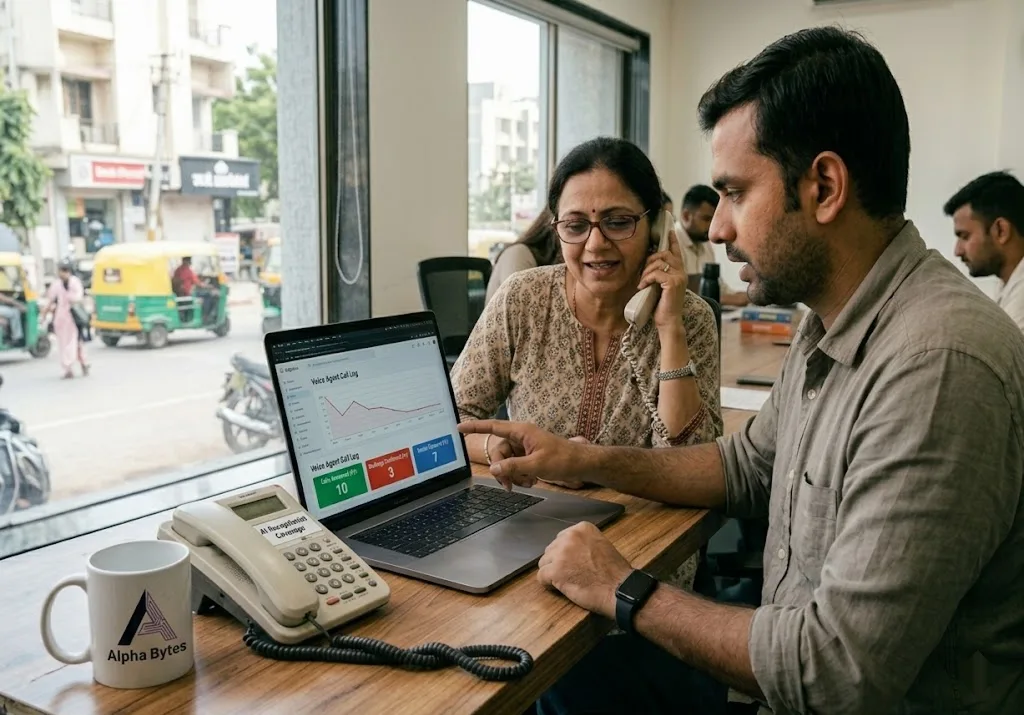
A salon owner in Ahmedabad once told us something that stuck with us: "I know I'm losing bookings. I just don't know how many, because I never hear from the people who couldn't get through." That single sentence describes one of the most expensive, least-visible problems in small business the calls that ring out, go to voicemail, or arrive after closing time, and simply vanish. The customer doesn't leave an angry review. They don't complain. They just call the next business on the list.
80% of callers who reach voicemail hang up without leaving a message. Every one of those calls represents a person who had a need, picked up the phone, and reached out to you specifically and then disappeared because nobody answered in time. In 2026, the fix for this problem has changed completely. AI phone receptionists voice agents that answer calls naturally, understand what the caller needs, and book appointments or capture details have moved from an enterprise novelty to an affordable, practical tool that small businesses are adopting at speed. This guide explains what AI receptionists actually are, what they can and can't do, what they cost, and how to know if your business needs one.
How Many Customers Are You Actually Losing to Missed Calls?
Most business owners underestimate this number significantly, because the calls that go unanswered leave no trace in any system they're looking at.
The Math Most Businesses Never Do
Consider a small clinic, salon, or service business receiving 25 calls a day. If even 30% of those calls happen outside business hours, during peak periods when staff are busy with customers, or simply ring through to an empty desk that's roughly 7–8 calls a day going unanswered. At a conservative conversion rate of one in three callers becoming a paying customer, that's 2–3 lost customers every single day. Over a month, that's 60–90 potential customers who called, didn't get through, and went elsewhere.
One HVAC contractor calculated that missed after-hours calls alone emergency calls, which by definition happen outside normal hours represented thousands of dollars in lost jobs every month, because emergency service calls almost never wait for a callback. The caller with a burst pipe at 9pm calls the next plumber on the list, not the one who might call back tomorrow.
Why This Connects Directly to Everything Else About Your Online Presence
If you've worked on getting your business found online your Google Business Profile, your website, your reviews every one of those efforts drives a phone call or enquiry to your business. If that call isn't answered, the work that got the customer to pick up the phone is wasted. This is the same logic covered in our guide on why businesses lose customers online visibility without follow-through doesn't convert. A missed call is the phone equivalent of a website visitor who can't find your contact form.
What Is an AI Phone Receptionist, in Plain English?
An AI phone receptionist is a voice-based AI assistant that answers your business phone line, has a natural conversation with the caller, and completes useful tasks answering questions, booking appointments, capturing contact details, or routing the call to a person without a human picking up.
It is not the touch-tone phone menu you're used to ("Press 1 for sales, press 2 for support"). Those systems are rigid and frustrating because they force the caller through a script. An AI receptionist holds an actual conversation. A caller can say "Hi, I was wondering if you're open on Sundays and whether you take walk-ins" and get a natural spoken answer the same way a human receptionist would respond.
What It Actually Does During a Call
- Answers within 2–3 rings, every time, regardless of time of day
- Greets the caller using your business name and a tone that matches your brand
- Answers common questions hours, location, pricing, services, parking, what's included using information you've provided about your business
- Books appointments by checking your calendar and offering available slots, the same way our AI-powered healthcare booking system handles online bookings, but over the phone
- Captures caller details name, number, reason for calling so you have a complete record even if no action was completed on the call
- Routes urgent or complex calls to a real person when the conversation goes beyond what it's set up to handle, rather than trying to force every call through automation
What It Is Not
An AI receptionist is not a replacement for your team's expertise, your sales conversations, or the relationships that close deals. It is not designed to handle complex negotiations, sensitive complaints, or anything requiring judgment. The honest framing and the one we use with every client considering this is that AI receptionists are designed to capture the routine calls so your team can focus on the calls that actually need them. The businesses thriving with this technology aren't trying to answer every call themselves; they're using AI to capture the routine 70% so they can focus on the valuable 30% that needs real expertise.
How an AI Receptionist Actually Works The Technology Behind the Conversation
Understanding the basic mechanics helps you evaluate options and have informed conversations with vendors without needing to become technical yourself.
The Four-Step Process Behind Every Call
- Speech to text: when the caller speaks, the system converts their spoken words into text in real time
- Understanding and response generation: an AI language model (similar to the technology behind ChatGPT and Claude) reads that text, understands what the caller is asking, and generates an appropriate response based on the information you've given it about your business
- Text to speech: the response is converted back into natural-sounding spoken audio
- Action execution: if the caller wants to book an appointment or needs information looked up, the system connects to your calendar, booking system, or knowledge base to complete that action
This entire process happens in real time, with response times fast enough that the conversation feels natural rather than like talking to a delayed recording. The quality difference between platforms comes down to how naturally each step flows into the next voice quality, response speed, and how well the AI handles unexpected questions that weren't anticipated in its setup.
What "Setting It Up" Actually Involves
Setting up an AI receptionist involves mapping out your call flow identifying the most common reasons customers call and then providing the information the AI needs to handle those calls: your hours, services, pricing, FAQs, and how your booking process works. This is the same kind of structured information that makes your website convert well clear, specific answers to the questions your customers actually ask, organised so a system (whether AI or a new staff member) can use them confidently.
For most small businesses, the setup process takes a few hours to a few days not weeks. The businesses that get the most value are the ones who spend that initial time thinking carefully about their actual call patterns: what do people call about most often, what information do they need, and what should happen when the AI doesn't know the answer.
What This Actually Costs and Why the Math Is Different From What You'd Expect
This is the part of the conversation that surprises most business owners, because the comparison isn't what they expect.
The Real Cost of a Human Receptionist
A full-time receptionist costs roughly $33,960 per year in salary, plus $11,000–$16,000 in benefits totaling $3,750–$4,000 per month. And that person works approximately 40 hours a week. The other 128 hours of the week evenings, weekends, lunch breaks, sick days your calls go to voicemail regardless.
The Cost of an AI Receptionist
AI voice agents for small businesses typically range from $65 to $499 per month, depending on call volume and the platform. Some platforms charge per minute of usage, which for a business with moderate call volume often totals a few hundred dollars per month. The AI answers every call, 24 hours a day, 7 days a week, handles multiple callers simultaneously if several people call at once, and never calls in sick.
The Honest Comparison
This is not framed as "replace your receptionist with AI" for most small businesses most small businesses don't have a dedicated receptionist in the first place. The realistic comparison is: AI receptionist versus no receptionist, where "no receptionist" means a phone that rings out, a voicemail box that 80% of callers won't use, and an unknown number of lost customers every month.
For businesses that do have a receptionist or front-desk staff, the most common and effective setup isn't replacement it's coverage. The AI handles after-hours calls, lunch breaks, and overflow when multiple calls come in at once, while your team continues handling calls during business hours. This is the same "AI plus human" approach we recommend for website chatbots and enquiry automation AI captures everything, humans handle what genuinely needs them.
Which Businesses Get the Most Value From AI Phone Receptionists
This technology isn't equally valuable for every business and being honest about where it helps most (and where it helps less) is part of making a good decision.
Highest Value: Businesses With Time-Sensitive or After-Hours Calls
Home services (plumbers, electricians, HVAC, locksmiths): emergency calls happen at all hours, and the caller with an urgent problem calls the next provider immediately if they don't get through. An AI receptionist that can answer, gather details about the issue, and either book an appointment or flag it as urgent for immediate callback directly converts calls that would otherwise be lost entirely.
Healthcare and clinics: patients calling to book, reschedule, or ask about appointments often call during lunch hours or evenings when front-desk staff are unavailable. We've seen this pattern directly in our healthcare booking system work a significant share of booking activity happens outside the hours a small front-desk team can realistically staff.
Restaurants and salons: booking and reservation calls spike during the exact hours staff are busiest serving existing customers. An AI receptionist that can take a reservation or booking without pulling staff away from customers in front of them directly protects revenue during peak hours.
Moderate Value: Professional Services
Consultants, agencies, accountants, real estate agents call volume is often lower, but each call represents higher potential value. The priority here isn't volume capture so much as ensuring no enquiry goes unanswered and is logged properly. An AI receptionist that captures caller details and the reason for their call even if it then routes to a human for the actual conversation ensures nothing falls through the gap, similar to the automated follow-up systems that prevent website enquiries from going cold.
Lower Priority: Businesses With Very Low Call Volume or Highly Complex Calls
If your business receives only a handful of calls a week, or if nearly every call requires nuanced, relationship-based conversation that genuinely can't be templated an AI receptionist may add cost without proportional benefit. In these cases, the higher-impact investment is often elsewhere your website's conversion rate or your online visibility before adding phone automation to a channel that isn't yet generating significant volume.
What Good Implementation Looks Like and What to Avoid
The difference between an AI receptionist that genuinely helps your business and one that frustrates your customers comes down to implementation, not the underlying technology.
Get This Right: Honest Expectations for the Caller
The AI receptionists that work best don't pretend to be human and don't need to. Callers generally respond well to a natural-sounding AI assistant that's clearly helpful what frustrates callers is an AI that can't understand them, loops unhelpfully, or refuses to connect them to a person when they genuinely need one. A well-implemented system always has a clear path to a human for anything outside its scope.
Get This Right: Start With Your Most Common Calls, Not Every Possible Scenario
The mistake we see most often is businesses trying to anticipate every possible call scenario before launching. The better approach: identify the five to eight things people call about most often hours, pricing, booking, location, a specific service question and build a system that handles those exceptionally well. Everything else routes to a human, with the AI capturing the caller's details so the follow-up is fast and informed.
Get This Right: Review What the AI Is Actually Doing
Every AI receptionist platform provides call logs and, increasingly, post-call analysis that flags calls where the caller seemed frustrated or where the AI couldn't help. Reviewing these regularly at least weekly when first implemented tells you exactly where to refine the setup. This is the same iterative approach that makes any AI automation in a business actually work well over time: start narrow, measure what happens, expand based on real data rather than assumptions.
Avoid This: Treating It as "Set and Forget"
An AI receptionist configured once and never reviewed will drift out of step with your business new services you've added, pricing that's changed, hours that have shifted for a season. The businesses getting the most value treat the AI's knowledge base the way they'd treat training a new team member: an initial setup, followed by ongoing updates as the business changes.
How This Fits Into Your Broader Digital Presence
An AI phone receptionist works best as one part of a connected system not an isolated tool bolted onto an otherwise disconnected business.
When a call comes in and the AI books an appointment, that booking should ideally land in the same calendar your team already uses not a separate system requiring manual reconciliation. When the AI captures a caller's details for a query it couldn't resolve, that information should flow to wherever your team manages follow-ups the same place website enquiries and chatbot conversations land, so nothing gets tracked in three different places.
This is the principle behind everything we build at Alpha Bytes: individual tools a chatbot, a booking system, a phone receptionist are most valuable when they're connected to the same underlying data, so a customer's journey across channels is coherent rather than fragmented. The complete picture of how AI and web systems work together for a growing business covers this connected approach across every channel, not just the phone.
How to Get Started: A Realistic First Step
You don't need to commit to a full system overhaul to find out whether this is worth it for your business.
- Track missed calls for one week. Most phone systems show missed call logs even if you've never looked at them. Count how many calls go unanswered, and at what times. This single piece of data specific to your business tells you more than any general statistic in this guide.
- List your five most common call reasons. Ask whoever currently answers your phone (even if that's you) what people call about most. This becomes the foundation of what an AI receptionist needs to handle well.
- Try a platform's free trial with a real scenario. Most AI receptionist platforms offer a free trial. Set it up with your actual business hours, services, and a few FAQs, then call it yourself and have someone else call it too try to ask it something tricky.
- Start with after-hours only if you're cautious. A common, low-risk starting point is having the AI handle only calls outside business hours, while your team continues handling calls during the day. This captures the calls you're currently losing entirely, with minimal change to how your business operates during the day.
- Review after 30 days. Look at the call logs. How many calls did the AI handle? How many were after-hours calls that would previously have gone to voicemail? How many converted into bookings or enquiries? This data tells you whether to expand the system's scope.
Final Thoughts
The phone is still one of the most direct paths a customer has to your business and unlike a website visitor who might browse for a while before deciding, someone calling you has usually already decided you're a strong candidate for their business. Losing that call to voicemail isn't a minor inconvenience. It's the loss of a customer who chose you specifically, at the exact moment they were ready to act.
AI phone receptionists aren't about replacing the personal touch that makes small businesses different from large ones. They're about making sure that personal touch gets the chance to happen by ensuring every call that comes in gets a response, every booking opportunity gets captured, and your team's time goes toward the conversations that genuinely need them.
If you want to understand what this would look like for your specific business your call patterns, your booking system, your team's setup reach out to Alpha Bytes for a direct conversation. No obligation, just clarity on whether this is the right next step for you.