
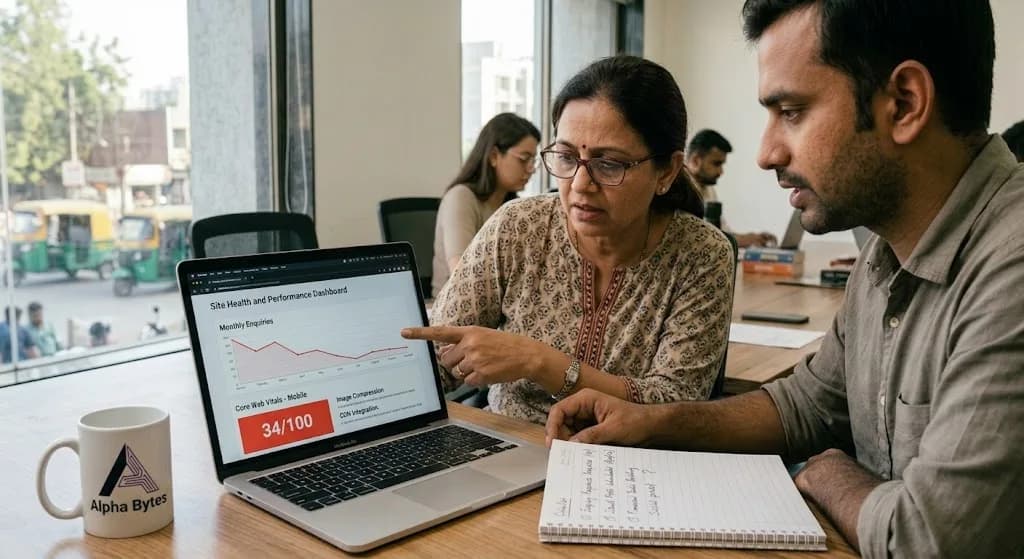
A clinic owner in Ahmedabad spent ₹85,000 on a website three years ago. It looks professional. It has photos, a services list, a contact page, and the business name in the header. When we asked her how many clients it had brought in over those three years, she went quiet and said: "I'm not sure it's brought in any." She wasn't wrong. The website had received thousands of visitors we could see this in Google Search Console and had generated a total of eleven contact form submissions, seven of which were spam. For a business spending money on hosting, paying someone occasionally to update it, and listing it on every piece of marketing material she printed, the website was returning almost nothing.
In 2026, most business owners are not asking whether they need a website. They are asking better questions whether their website is doing its job, whether they should fix what they have or start over, and how much attention it really needs to support their actual business goals. This guide answers those questions. It's not written for developers. It's written for business owners who want a plain-English way to evaluate what their website is actually doing and what to do if it isn't doing enough.
Why Most Business Owners Don't Know If Their Website Is Working
The honest reason is simple: nobody told them what "working" looks like. A website gets built, it goes live, the developer says it's done, and the business owner moves on to the hundred other things competing for their attention. Without a clear definition of what success looks like specific numbers, specific outcomes there's no way to know if the site is performing or failing.
Most small business owners don't need a brand new website every few years. They need clarity about what their website is doing well, clarity about what is getting in the way, and clarity about what matters most right now. That's exactly what this guide provides a way to get that clarity in about 30 minutes, without needing a technical background.
The 7 Questions That Tell You Everything About Your Website's Performance
Work through these seven questions honestly. By the end, you'll know which of three categories your website falls into: working well and just needs maintenance, working partially and needs specific fixes, or not working and needs a strategic overhaul.
Question 1: Can a Stranger Describe Your Business After 10 Seconds on Your Homepage?
This is the most important test in this entire guide. Right now, open your website on your phone and ask someone your partner, a friend, a neighbour to look at the homepage for 10 seconds and then describe what your business does and who it's for.
If they hesitate, give a vague answer, or describe something incomplete or incorrect your website has a fundamental communication problem that no amount of SEO, ads, or design improvement will fix. Before a visitor can decide whether to contact you, they need to instantly understand whether you solve their specific problem.
A homepage that works answers three things above the fold (without scrolling): what you do, who you do it for, and what the visitor should do next. If your homepage currently leads with your business name, a slogan that sounds clever but says nothing specific, or a large background image with no text explaining the business that is the first thing to fix. Not the colours. Not the font. The words.
Question 2: How Many Enquiries Did Your Website Generate Last Month?
Not visitors. Enquiries. Phone calls, form submissions, booking requests, direct emails that started with "I found your website." If you don't know this number if nobody is tracking it that is itself an important finding.
A professional website for a service business should be generating enquiries every month. Not necessarily hundreds. But a consistent, growing number of people who found the site and decided to get in touch. If your website gets meaningful traffic (more than 500 visitors per month) and generates fewer than five genuine enquiries monthly, something specific is broken and it's fixable.
The calculation that matters is not "how many visitors" but "what percentage of visitors take action." That percentage is your conversion rate, and it's the single most important number in website performance. We've covered the nine specific reasons conversion rates stay low and the exact fix for each in our guide on why websites don't generate leads. If your answer to this question is "almost no enquiries," that's your starting point.
Question 3: Can You Find Your Business on Google When a Stranger Searches for It?
Open Google in an incognito window so your own browsing history doesn't influence the results and search for what a potential client would search. Not your business name. What they'd type before they've heard of you.
"Web development agency Ahmedabad." "Physiotherapy clinic near me." "Custom cake shop Surat." "Accountant for small business Gujarat." Whatever describes what you do and where you do it.
Does your business appear? On the first page? In the Google map results? If a potential client searched for exactly what you offer in your city right now, would they find you or would they find your competitors?
If you don't appear, your website exists but it's effectively invisible. It's like having a shop with no sign on a back street with no pedestrian traffic. A website that can't be found by people searching for your services generates no leads regardless of how well-designed it is.
Question 4: Does Your Website Work on a Phone?
Open your own website on your actual phone not a laptop, your real phone and try to do what a visitor would do. Read the main message. Find the contact details. Fill out the enquiry form. Tap the call button if there is one.
Note every moment of friction. Text that's too small to read without zooming. Buttons that are too close together to tap accurately. A form that's painful to complete on a touchscreen. A phone number that doesn't trigger a call when tapped. Navigation that requires horizontal scrolling.
In 2026, users visit on mobile, make a decision in seconds, and leave if the experience is poor. If you felt even mild frustration during that test, your mobile visitors felt the same and most of them left without contacting you.
Question 5: How Fast Does Your Website Load?
Visit PageSpeed Insights, type your website address, and run the test on Mobile. Look at the score that appears. Below 50 is a serious problem that's actively costing you clients. Between 50 and 70 needs improvement. Above 70 is acceptable. Above 90 is where you want to be.
Speed matters more than most business owners realise. A website that takes more than 3 seconds to load loses a significant proportion of visitors before they've seen a single word of content. Those visitors didn't choose your competitor because they preferred them they chose them because they never waited long enough to see what you offered.
The good news is that most speed problems are fixable without rebuilding your entire website. Image sizes, caching, and a CDN (a tool that serves your website faster from servers close to your visitor's location) fix the majority of speed problems. Our website speed guide walks through every fix in plain English with no technical background required.
Question 6: Do You Have Any Social Proof on Your Website?
Social proof is evidence that real people have used your service and had a positive experience. It's testimonials with full names. It's case studies showing a before and after. It's client logos if you've worked with recognisable names. It's the number of clients served or years in business.
Potential clients want to see proof that the business delivers what it promises not claims, but evidence.
Now go to your homepage and your main services page. Count how many pieces of real, specific social proof are visible without scrolling past the first two sections. "Client testimonials" with no names, or a generic "our clients love us" statement, don't count. A specific outcome from a named client counts. A Google review screenshot counts. A before-and-after case study counts.
If the answer is none, or if your only social proof is vague and unattributed, you're asking visitors to take your word for everything and in 2026, that's not enough. People check. People look for evidence. If your website doesn't provide it, they find it elsewhere, and sometimes what they find is nothing which leads to them choosing someone whose website does provide it.
Question 7: What Happens After Someone Enquires?
This question is about your process, not your website but it directly affects whether your website's lead generation effort translates into actual clients.
When someone fills out your contact form right now, what happens? Do they get an automatic response acknowledging receipt? Do they know when to expect a reply? Do you have a process that ensures every enquiry is followed up within a specific timeframe?
The businesses that convert the highest percentage of website enquiries into paying clients are not necessarily better at their core service. They're faster, more organized, and more professional in how they handle the initial contact. An enquiry that doesn't receive a response within four hours is half as likely to convert as one responded to within the hour. An enquiry that receives an automated "we'll be in touch" with no timeframe is significantly less likely to convert than one that receives a personalised response with a clear next step.
We've helped clients set up automated response systems that handle this problem entirely the moment an enquiry arrives, an AI-generated personalized acknowledgement goes out, a follow-up is scheduled, and the lead is logged in a CRM automatically. The AI automation systems we build for clients have recovered a meaningful proportion of enquiries that would otherwise have gone cold simply because life got in the way of a timely reply.
What Your Answers Mean
Based on your answers to the seven questions, your website falls into one of three situations each with a different appropriate response.
Situation 1: Your Website Has Good Foundations but Needs Specific Fixes
You appear in Google search. Your speed score is reasonable. You get some enquiries. But the conversion rate is lower than it should be, the mobile experience has friction, or your social proof is thin.
This is the most common situation, and the most encouraging because it means the fundamental infrastructure is working and targeted improvements produce measurable results quickly. Prioritise in this order: add specific testimonials with real names and outcomes, reduce your enquiry form to three fields, fix your homepage headline to be more specific about who you help and what outcome you deliver, and run your mobile experience through the test in Question 4.
Most businesses in this situation see meaningful conversion rate improvement within 30 days of making these changes with the same traffic they're already receiving.
Situation 2: Your Website Is Invisible
You don't appear in Google when a stranger searches for your service. You get very few visitors. The people who do find you come almost entirely from referrals or direct traffic people who already knew your business name.
This is a visibility problem, not a conversion problem. Your website may convert well for the few visitors it receives, but those visitors are too few to generate a sustainable pipeline. The fix here is a combination of Google Business Profile optimization, local SEO, and content that answers the questions your potential clients are searching for.
If you're wondering whether to get your business found on AI search the answer is yes, and doing so is now as important as appearing in regular Google results. AI search platforms like Perplexity, ChatGPT, and Google AI Overviews are where a growing percentage of your potential clients now start their research.
Situation 3: Your Website Exists but Isn't Doing Anything
You're invisible in search. The few visitors you get don't enquire. The mobile experience is poor. The speed score is below 50. Your homepage doesn't clearly explain what you do.
This is the situation the clinic owner from our opening story was in and it's more common than most business owners realize, because the website looked fine on the surface. A website can be visually professional and functionally useless at the same time. The appearance of a website and its business performance are entirely separate things.
If this is your situation, the conversation isn't about minor fixes. It's about rebuilding with the right foundation a platform that loads fast, a structure that Google can index, content that communicates clearly, and a user experience designed for conversion rather than aesthetics. The platform question whether to use WordPress or something faster like Next.js matters a great deal here, because some platforms are fundamentally better at the technical requirements that underpin website performance.
The Three Things That Determine Whether a Website Works and How to Think About Each One
Once you've diagnosed your situation, it helps to understand the three underlying factors that determine whether a website generates business. Everything in this guide is a symptom of one of these three.
Factor 1: Visibility: Can People Find You?
Visibility is about being discoverable by people who don't already know you exist. It's your Google ranking, your Google Business Profile, your presence in AI search, and your social media footprint. Without visibility, every other website improvement is irrelevant you can't convert visitors who never arrive.
The primary visibility tool for a local service business in 2026 is a complete, actively managed Google Business Profile paired with a website that contains location-specific, question-answering content. These two work together the profile drives local search visibility, the website provides the depth that converts searchers into enquiries and also supports ranking.
Factor 2: Credibility: Do Visitors Trust You Enough to Contact You?
Credibility is about what happens in the 90 seconds after a visitor arrives. Do they see specific evidence that your business delivers what it promises? Do they understand who else you've helped and what outcomes those clients experienced? Is your contact information visible without hunting? Does the overall presentation design, writing, and speed match the standard they'd expect from a business at your price point?
Credibility problems are almost always fixable without a rebuild. They're almost always about adding something missing rather than removing something wrong specific testimonials, a case study, a visible phone number, a named person behind the business.
Factor 3: Conversion: Is It Easy to Take the Next Step?
Conversion is about friction. Every step a visitor has to take scrolling to find contact details, filling in unnecessary form fields, waiting for a slow page to load, struggling with small tap targets on mobile reduces the probability that they'll complete the enquiry.
The businesses with the highest website conversion rates don't necessarily have the best-designed websites. They have the simplest path from "I'm interested" to "I've made contact." One clear call to action per page. A form with three fields maximum. A phone number visible on every page. A response that arrives within an hour of submission. These details are responsible for more lost clients than any design decision.
What to Do This Week Based on Your Findings
Reading this guide and doing nothing produces nothing. Here's the specific action for each finding:
- Homepage isn't clear: Rewrite your hero headline this week. New formula "We help [specific type of client] [achieve specific outcome] through [your approach]." One sentence. Test it with the 10-second stranger test before publishing.
- No social proof: Email your last five clients today and ask for a testimonial. Specific ask: "Would you be willing to write 2–3 sentences about your experience and the results you've seen? I'd love to add it to our website." Most will say yes if asked directly.
- Invisible in Google: Set up or complete your Google Business Profile today. The setup is free and takes two hours. Then ask every client for a Google review not occasionally, every time.
- Bad mobile experience: Fix the three biggest friction points you found in your phone test. Start with tap target sizes and form field count.
- Slow speed: Run PageSpeed Insights, screenshot the "Opportunities" section, and send it to whoever manages your website. These are prioritised fixes the first three on the list typically produce most of the improvement.
- No enquiry follow-up system: Set up an automatic email response for your contact form. Even a basic autoresponder that says "Thanks for reaching out we'll be in touch within [timeframe]" meaningfully improves the percentage of enquiries that stay warm long enough to convert.
- Overall website isn't working: Have a conversation with a web agency not to buy anything, but to get a professional assessment of what the actual problem is and what fixing it would realistically cost and take. We do this for free with no obligation. Most business owners find that clarity about the problem is worth more than any amount of guessing.
How Much Should a Business Website Actually Cost and Is What You Have Worth Fixing?
This is the practical question behind everything in this guide. Every business owner evaluating their website eventually asks: should I fix what I have, or would it be better to start fresh?
The answer depends on the platform, the age of the site, and how far it is from where it needs to be. Here's the honest framework we use with clients:
Fix What You Have When:
- The platform is modern (WordPress updated in the last two years, Shopify, Webflow) and technically capable of improvement
- The problems are primarily content and conversion missing social proof, unclear headline, poor mobile CTA rather than structural
- The site is less than three years old and was built by a competent professional
- The investment in a rebuild would significantly exceed the investment in targeted fixes
Consider Starting Fresh When:
- The site was built on an outdated platform with fundamental limitations that can't be fixed at the theme level
- The business has significantly changed different services, different audience, different positioning and the site no longer represents what you actually offer
- The speed score is below 30 on mobile and cannot be meaningfully improved without rebuilding the theme architecture
- The site hasn't been updated in three or more years and carries accumulated technical problems that would be more expensive to untangle than to rebuild
At Alpha Bytes, a targeted website fix engagement addressing specific conversion, speed, and content problems on an existing site typically costs between ₹10,000 and ₹60,000 depending on scope. A new website built from scratch, properly, ranges from ₹30,000 to ₹5,00,000 depending on complexity. In most cases, targeted fixes deliver better short-term ROI. In some cases, a fresh start is genuinely the more economical decision over a three-year horizon.
If you're not sure which applies to your situation, the fastest way to find out is a website audit a professional assessment of what's working, what isn't, and what fixing it would actually involve. We do this for free with no obligation attached.
A Note on AI and Your Website in 2026
The website conversation in 2026 includes something that didn't exist two years ago: AI search. Your potential clients are increasingly not just searching on Google. They're asking ChatGPT "which web agency should I use in Ahmedabad" or asking Perplexity "best physiotherapy clinic near me." If your business doesn't appear in those answers even if it ranks well on Google you're invisible to a growing and increasingly valuable slice of your target audience.
Getting cited in AI search answers requires specific signals that many existing websites don't have: schema markup, structured question-and-answer content, named author attribution, and third-party mentions on trusted directories. We've built this into every website we've delivered in the past 18 months, and we've seen AI citations appear for client websites within 4–8 weeks of implementation. This isn't a future consideration. It's a present-tense competitive advantage for businesses that move on it now. The full strategy is covered in our guide to getting found on AI search.
Final Thoughts
Your website is either working for your business or it isn't. There's no neutral position. A website that costs money to host, costs attention to maintain, and generates no enquiries is not a neutral presence it's a cost without a return. And that's fixable. Almost every underperforming website we've audited had specific, diagnosable problems that pointed directly to specific solutions. The mystery of "why isn't our website generating business" rarely turns out to be a mystery at all. It turns out to be an unclear headline, a form with too many fields, a speed score that drives visitors away before the page loads, or a Google presence that never existed in the first place.
If you worked through the seven questions in this guide and you now know what's broken, you're in a better position than you were before you started. If you're still not sure, a 30-minute conversation with a web professional who can look at the actual data from your website will give you more clarity than another month of wondering.
Explore the complete AI and web guide for business owners for everything covered in one place, or reach out to Alpha Bytes we're happy to look at your specific website and give you a direct, honest assessment of what's working and what isn't.