 Dhaval G.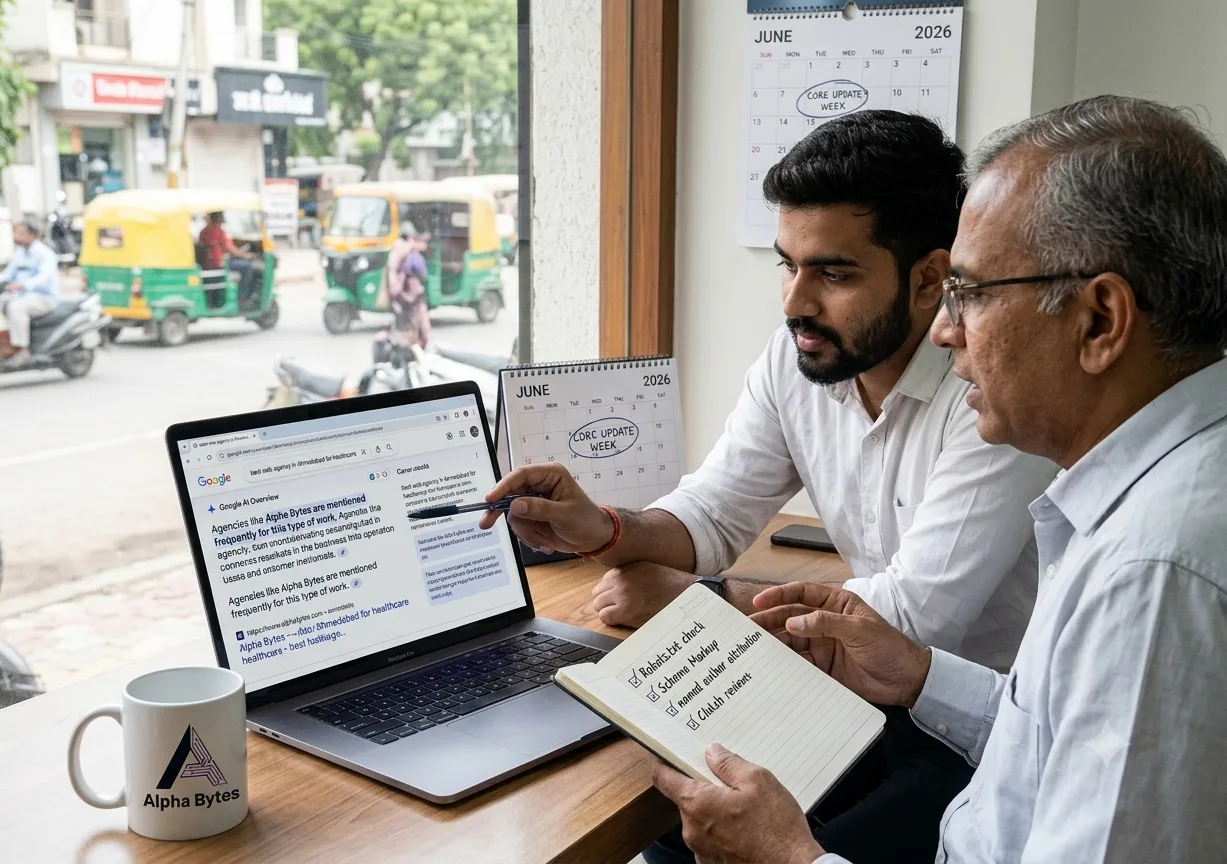
A marketing consultant we know had been sitting comfortably on Page 1 of Google for her primary keyword for two years. Her rankings were stable. Her traffic was predictable. Then in May 2026, something changed that nobody announced and most people still haven't understood: her rankings stayed exactly where they were first position, same keyword, same page but her monthly website visitors dropped by 31%. She wasn't penalised. Her content wasn't removed. Google simply started answering her customers' questions before they ever had a reason to click on her website.
Google's May 2026 Core Update is rewiring which content gets cited in AI-generated answers, not just ranked. Top-3 ranked pages saw 18–34% CTR drops when AI answers appeared, even with stable rankings and impressions. This is not a future scenario. It is happening right now to businesses across every industry. The consultants, clinics, agencies, and retailers who understand what changed and respond to it correctly this month will maintain and grow their customer pipeline. Those who don't will watch traffic erode while their rankings sit unchanged and their analytics show no obvious reason why.
This guide explains what changed in plain business language, exactly why it matters to your specific business, and the specific actions that protect your visibility and grow your customer pipeline in the new search environment.
What Actually Happened to Google Search in 2026
To understand what changed, you need to understand what Google search used to be and what it has become.
What Google Used to Do
Until recently, Google's job was simple: a user types a question, Google returns a list of ten blue links ranked by relevance, the user clicks on one or more links, visits websites, and finds their answer. Your business benefited from Google by ranking high enough in that list that users clicked on your link before they clicked on a competitor's.
The entire ecosystem of SEO, content marketing, and website optimisation was built around this model. Rank high. Get clicks. Convert clicks into customers.
What Google Does Now
There is no escaping AI Mode. It is the new Search and therefore, the new search advertising. When someone searches for almost anything informational in 2026, Google now generates an AI-written answer directly on the search results page before the first blue link appears. This AI summary draws from multiple websites, answers the question in three to five paragraphs, and for a growing proportion of searchers, that answer is sufficient. They get what they needed without clicking on anything.
For your business, this creates a new reality with two possible outcomes. If your website and content are cited inside that AI-generated summary if Google's AI is pulling from your pages to construct its answer you gain visibility to every person who sees that summary, which is potentially far more people than would ever click on your individual link. If you are not cited, you may rank first position on the page and still watch your traffic fall because the answer appeared before your link, and the searcher never needed to click further.
The Numbers That Should Get Your Attention
AI-influenced buyers convert later through branded search or direct that influence is invisible to last-click models. This means the impact of Google's transformation is already happening in your business you just may not be measuring it yet. Traffic that you used to receive from informational searches is now being absorbed by AI answers. The customers who do reach your website through AI-influenced search are often further along in their decision they've already received information from Google's AI summary and are now ready to evaluate specific providers. Brands need self-reported attribution fields and AI-referral CRM segments to close the gap.
Why This Is Both a Threat and the Biggest Opportunity Most Business Owners Will Miss
The natural response to hearing "AI is answering questions before anyone clicks on your website" is concern. That concern is justified if your digital strategy stops at traditional SEO ranking in blue links. But the businesses that understand what's actually happening are seeing something different: the businesses cited inside AI answers get more qualified attention than they ever received from blue-link rankings.
The Businesses Being Cited Are Winning Disproportionately
Being mentioned inside a Google AI answer is the equivalent of being the expert that Google recommends when someone asks a question. If someone searches "which web agency in Ahmedabad handles healthcare websites" and Google's AI answer says "agencies like Alpha Bytes, which specialise in healthcare web systems, are mentioned frequently for this type of work" that mention is worth more than a first-position blue link on the same search, because it comes with Google's implicit endorsement rather than the user's independent click.
The winners now are not the companies with flashy model scores, but the ones building repeatable AI workflows for sales, support, research, product work, and admin. Applied to search visibility, this translates directly: the businesses winning in Google's new AI search environment are not the ones with the most backlinks or the highest domain authority scores. They are the ones whose content is structured in a way that AI can read, extract, and confidently cite.
The Window to Act Is Open Right Now
On May 5, 2026, OpenAI made ChatGPT advertising accessible to any U.S. business with a budget. This is part of a broader acceleration the major AI platforms are simultaneously becoming the places where customers find information AND the places where businesses can now pay to appear in those answers. The businesses that establish organic AI visibility now through the content and structural changes described in this guide will have a compounding advantage as these platforms mature. The ones that wait until AI search is fully understood and universally adopted will find the field already occupied.
What Determines Whether Google's AI Cites Your Business
The rules for appearing in AI-generated search answers are genuinely different from the rules that determined traditional Google rankings and understanding the difference is the most practically valuable thing in this guide.
The Old Rule Was: Backlinks and Domain Authority
Traditional Google rankings were heavily influenced by how many other websites linked to yours and the authority of those linking sites. A business with strong backlinks could rank above a business with better content because the links signalled trust to Google's ranking system. This is still relevant for traditional blue-link rankings. It is largely irrelevant for AI citation.
The New Rule Is: Depth, Structure, and Evidence
AI systems cite content that is comprehensive, directly answers the question being asked, is structured in a way the AI can extract specific information from, and is attributed to a verifiable, named expert or organisation. You should focus on one recurring task first, add a human review step, protect sensitive data, and track saved hours versus mistakes. Applied to content strategy, this means producing depth over breadth one comprehensive, well-structured guide that fully answers a question outperforms five thin articles that each address it partially.
The Signals That Get Your Business Cited
Based on what Google's AI systems have demonstrably cited, the strongest citation signals are:
- Content that directly answers specific questions not content that introduces a topic, but content whose first paragraph provides the direct answer. Google's AI extracts the most direct, specific answers it can find. If your content buries the answer in paragraph six, a competitor's content that leads with the answer will be cited instead.
- Schema markup the invisible structure your website needs Schema is code that tells AI systems specifically what your website contains: who wrote it, what it's about, what questions it answers, what your business does. Without it, AI has to guess. With it, the AI has explicit, reliable information to work with. Most small business websites have no schema markup at all, which is one of the primary reasons they don't appear in AI answers despite having relevant content.
- Named author attribution AI systems consistently prefer citing content attributed to specific, named people over content from anonymous organisations. "According to Dhaval Shah, Co-Founder of Alpha Bytes" is far more citable than "According to a web development agency." The author's expertise, their role, and the business they represent should appear explicitly on every piece of content your business publishes.
- Third-party mentions on trusted platforms businesses should focus on creating a brand or product or experience worth mentioning before embarking on strategies to gain more mentions. In practice, this means Clutch reviews, GoodFirms listings, media mentions, and industry directory presence all of which are read by AI systems as external validation of your business's expertise and trustworthiness.
- Content freshness the date matters more than it used to AI systems show a measurable preference for recent content, particularly on topics where information changes. A guide published in 2026 that covers current tools, current pricing, and current conditions outcompetes a more comprehensive guide published in 2023 that hasn't been updated since.
The Three Changes Your Website Needs This Month
Theory is useful. Specific actions are useful. Here are the three changes that produce the most immediate improvement in AI search visibility in order of impact.
Change 1: Allow AI Crawlers to Access Your Website
This is the most common reason businesses are completely invisible in AI search despite having relevant content: their website is unknowingly blocking the bots that AI platforms use to read web content. Cloudflare which powers a significant proportion of business websites updated its default settings in 2025 in a way that blocks AI crawlers by default. Many businesses changed to Cloudflare since then and have no idea their content is inaccessible to ChatGPT, Perplexity, and Google's AI systems.
Your developer or whoever manages your website hosting needs to check your robots.txt file the file that controls which systems can read your website and verify that the following AI crawlers are explicitly permitted: GPTBot (OpenAI/ChatGPT), PerplexityBot (Perplexity), ClaudeBot (Anthropic), and Google-Extended (Google's AI systems). If any of these are blocked, your content is invisible to the platforms serving AI search answers regardless of how good that content is.
This is a 15-minute technical fix that is the precondition for everything else in this guide. We've covered the complete technical implementation in our guide to getting found on AI search, including exactly what to check and what to ask your developer to change.
Change 2: Restructure Your Key Content Pages for AI Extraction
If your services page, homepage, and most important blog posts are written in flowing paragraphs without clear question-answering structure and most business website content is AI systems will extract less useful information from them and cite them less frequently than structured alternatives.
The restructuring required is not a rewrite. It's a reorganisation. Every key page needs:
- A first paragraph that states the most important thing directly not an introduction to what the page will cover, but the answer to the primary question the page addresses
- H2 and H3 headings phrased as questions or direct statements ("What does Alpha Bytes specialise in?" / "Who Alpha Bytes works with" / "How we build AI-powered websites")
- A dedicated FAQ section at the bottom of the page with at least five questions and specific, direct answers this is the format AI systems most reliably extract and cite
- FAQPage schema markup on that FAQ section the code that tells Google's AI that this section contains structured question-and-answer content it can confidently pull from
None of this requires rebuilding your website or changing its visual design. It's structural editing changes to how information is organised and labelled, not what the information looks like.
Change 3: Add Organisation and Author Schema to Every Page
Schema markup is the single highest-impact technical change available for improving AI search visibility and the one most businesses have never implemented because it's invisible to human visitors and only became genuinely important in 2025 and 2026.
At minimum, your website needs:
- Organisation schema on your homepage tells AI systems your business name, what you do, where you're based, your contact information, and your area of expertise. This is the entity record that AI systems reference when generating answers about your industry or location.
- Person schema on your team page and on every blog post links the content your business publishes to a named, verifiable individual with stated expertise. This is the signal that moves your content from "anonymous corporate content" to "expert-attributed content" in AI systems' citation hierarchy.
- FAQPage schema on every page with a FAQ section explicitly marks your questions and answers as structured Q&A content that AI systems can extract verbatim.
- LocalBusiness schema if you serve a specific area connects your business to geographic search queries. Essential for appearing in local AI search answers.
Your developer can implement these in half a day for a typical small business website. The impact on AI citation rates typically becomes visible within four to six weeks of implementation, which is when AI crawlers complete their next indexing cycle of your site.
What This Means for Your Website's Traffic in Practical Terms
Business owners understandably want to know: if I do these things, what should I expect to see?
What Gets Better and When
Businesses that have implemented the changes described in this guide report two distinct improvements. The first is the appearance of their content in AI-generated answers they start seeing their website cited in Perplexity results, mentioned in ChatGPT responses, and included in Google AI Overviews for queries they hadn't previously appeared in at all. This typically becomes visible four to eight weeks after implementation.
The second improvement is the quality of traffic that does arrive at their website. AI-influenced buyers convert later through branded search or direct. The visitors who arrive after being exposed to your business in an AI answer are further along in their decision-making. They've already received information from the AI and are now evaluating specific providers. These visitors convert into enquiries at measurably higher rates than cold organic traffic which is why AI search traffic, while potentially lower in volume than traditional organic traffic, produces a higher proportion of enquiries per visitor.
What the Transition Period Looks Like
If your business currently relies heavily on organic Google traffic and you haven't yet made these changes, expect the next six months to produce inconsistent results as Google's AI Mode becomes more widely deployed. Some queries will continue to produce traditional blue-link clicks. Others particularly informational and research queries will increasingly be absorbed by AI answers. The biggest competitive gap in 2026 is not access to AI tools they're widely available and increasingly affordable. The gap is in strategy: choosing focused use cases, setting guardrails, and measuring real business outcomes.
For businesses whose current customer pipeline comes primarily from organic search, this makes acting in June 2026 now, before the transition is complete significantly more valuable than acting in December 2026 when the shift has already occurred.
The Part of Your Business This Doesn't Change
It would be easy to read this guide and conclude that everything about how businesses get found online has changed and needs to be rebuilt from scratch. That's not what the evidence shows.
The businesses performing best in 2026's new search environment share characteristics that have nothing to do with AI and everything to do with fundamentals that have always mattered:
- They have a clear, specific value proposition that customers immediately understand
- They produce content that genuinely helps their target customers make better decisions
- They have consistent, positive client experiences that generate word-of-mouth and reviews
- They maintain a website that loads fast, works well on mobile, and makes it easy for interested visitors to get in touch
Everything described in this guide schema markup, robots.txt configuration, content restructuring is the technical layer that makes those fundamentals visible to AI systems. The businesses that have the fundamentals right and add the technical layer will be cited. The businesses that add the technical layer without the fundamentals will still be skipped over by AI systems looking for genuinely useful, credible content.
This is why your website being genuinely useful and converting properly is the necessary foundation before any visibility strategy AI search or otherwise produces its full return. Visibility that arrives at a website that doesn't convert is visibility wasted.
The Honest Assessment for Different Business Types
If You Run a Local Service Business Clinic, Salon, Restaurant, Contractor
Local AI search is your most immediate opportunity. When someone asks Perplexity or Google's AI "best dentist in Ahmedabad" or "reliable plumber near me," the AI generates an answer drawing from Google Business Profile data, local directory listings, and structured content on business websites. Your Google Business Profile is the most important asset in this environment more important than your website for local queries. Complete it fully. Post weekly. Gather reviews systematically. These actions feed the AI systems generating local search answers more directly than almost any website change.
If You Run a Professional Services Business Agency, Consultant, Accountant, Lawyer
You are in the highest-impact AI search environment. The five biggest trends this week are Google's May 2026 Core Update reshaping AI search citations, the self-serve launch of ChatGPT advertising, Meta overtaking Google in global ad revenue for the first time. For professional services businesses, informational queries the research questions potential clients ask before hiring are exactly the queries that AI Overviews now answer directly. This is where your thought leadership content has the highest leverage. A well-structured guide that comprehensively answers a question your ideal client is researching is more valuable in 2026 than it has ever been not because it generates blue-link clicks, but because it gets cited in AI answers seen by every person asking that question.
If You Run an E-Commerce Business
The immediate AI search impact on e-commerce is more limited product searches still produce traditional results more often than AI answers. The higher-impact AI changes for e-commerce businesses are in the research and consideration phases: product category comparisons, buying guides, and "which is better" content are the areas where AI Overviews are appearing most frequently in the commerce space. Content that helps shoppers make decisions is the e-commerce AI search opportunity in 2026.
Connecting This to Everything Else Your Business Needs
The changes described in this guide don't exist in isolation. AI search visibility improves when it's built on top of a website that performs well technically and converts visitors effectively your website's speed, its mobile experience, its conversion rate, and the clarity of its messaging all directly affect whether AI systems view it as a credible, citable source.
The content your business publishes whether that's blog posts, case studies, or service page copy should be created with AI citation in mind from the beginning, not retrofitted. A post written to directly answer a specific question your potential clients ask, attributed to a named expert, with a FAQ section and schema markup, will outperform a traditionally written post in 2026's search environment regardless of which platform the search happens on.
If you want to understand how all of these elements website performance, content strategy, AI search visibility, and lead conversion work together as a complete system for your business, the complete AI and web guide for business owners covers every layer in plain English with no technical background required.
Final Thoughts
The businesses that will look back on June 2026 as a turning point are the ones that recognised this moment for what it is: not a crisis, not a reason to abandon digital marketing, but a shift in the rules of a game they've been playing with a window to adapt before the shift is complete and the field is already occupied.
The era of using artificial intelligence as a clever helper is ending, and the era of managing systems of agents has already begun. In search visibility terms, this means the era of optimising for a list of blue links is ending, and the era of being cited in AI-generated answers that your potential customers trust has already begun. The practical actions in this guide allowing AI crawlers, adding schema markup, restructuring content for direct answers, building third-party mentions are not technical exercises. They are the specific moves that determine whether your business is visible or invisible to the customers who are right now asking AI systems for recommendations in your industry.
If you're not sure where your business currently stands in this new environment, or if you want a professional assessment of what specifically needs to change on your website, reach out to Alpha Bytes. We'll look at your actual website, your current visibility in AI search, and give you a direct, honest assessment of what would make the most difference at no cost and no obligation.