 Dhaval G.
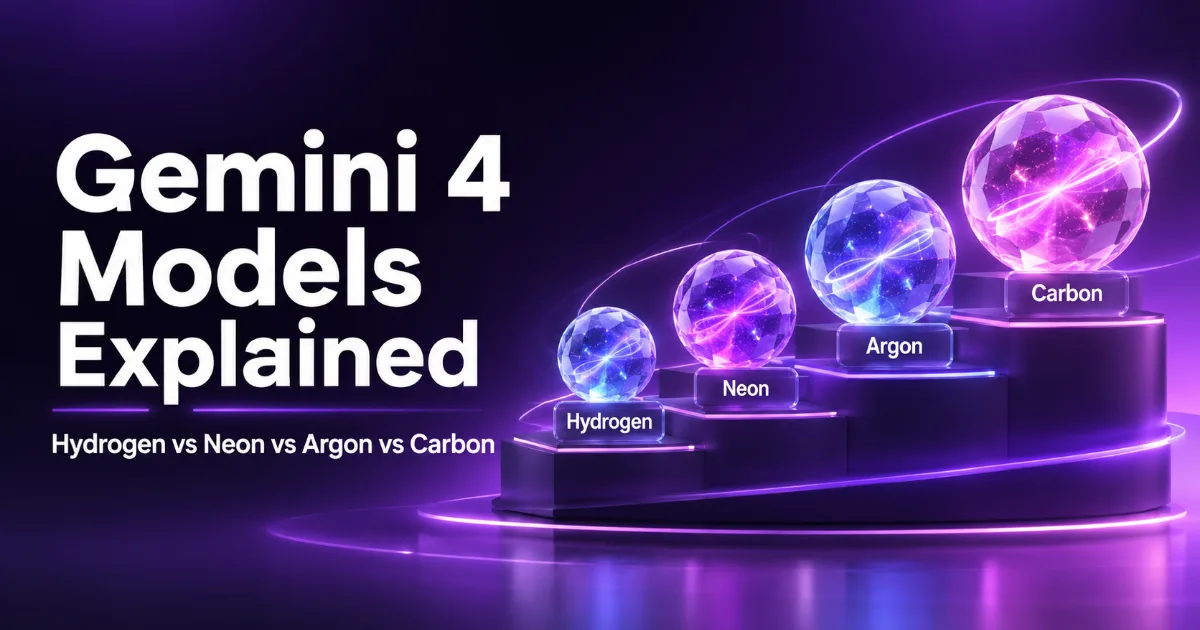
Short answer: Google's Gemini 4 family now has four models. Hydrogen (released 12 November 2026) is the fast, low-cost everyday model, available to everyone in the Gemini app and Google Search. Neon (18 November) is a mid-tier model that Google says comes close to its top models at much higher speed. Argon and Carbon are the frontier models for the hardest reasoning work, with Carbon at the top. For most businesses, Hydrogen handles everyday work, Neon is the sweet spot for serious analysis and coding, and Carbon is for the rare tasks that need maximum intelligence.
Google released two Gemini 4 models in a single week, and the names (chemical elements, not "Pro" or "Flash") don't make it obvious which is which. This guide explains the line-up using Google's own announcements and plan pages. We build AI automation on all the major model families, so the recommendations come from choosing models for real client work.
The four Gemini 4 models at a glance
| Model | Released | Built for | API price (per 1M tokens, in / out) | Where you get it |
|---|---|---|---|---|
| Hydrogen | 12 Nov 2026 | Fast everyday work, coding and agent tasks | $1.50 / $7.50 | Gemini app and Search for everyone; Gemini API; Gemini for business |
| Neon | 18 Nov 2026 | Near-frontier quality at speed: analysis, coding, science | $3 / $15 | Gemini app for Pro and Ultra subscribers; Gemini API; Gemini for business |
| Argon | Announced 30 Sep 2026 | Frontier reasoning | See Google's pricing page | Google AI Pro and above |
| Carbon | Rolled out broadly in November 2026 | The hardest, deepest reasoning tasks | See Google's pricing page | Google AI Ultra |
Hydrogen and Neon both have a 1 million-token context window, enough for very long documents, large spreadsheets or a whole codebase in one go.
Gemini 4 Hydrogen: the fast everyday model
Google describes Hydrogen as bringing "cutting-edge intelligence to everyone", with speed and efficiency for everyday coding and agent workflows. Key points from Google's announcement:
- Available to everyone: in the Gemini app's model menu, in Google Search for all users, and for developers in the Gemini API and Google AI Studio.
- Smarter than its price suggests: at its default "high" thinking level, Google says Hydrogen scores slightly above Argon on the Artificial Analysis Intelligence Index (51 vs 50), reaching 54 at its highest setting.
- A big upgrade from Gemini 3.8 Flash: Google reports tasks finishing about 2.5 times faster, coding-benchmark scores more than tripling, and fabricated claims cut by more than 5 times.
- Four thinking levels (low, medium, high and a new xhigh), so you only pay for the reasoning depth a task needs.
- Cheap at scale: $1.50 per million input tokens and $7.50 per million output tokens, flat across the full 1 million-token context.
For everyday users, Google says Hydrogen follows instructions more closely, sticks to your tone and format in emails and documents, and calls the right tools (Gmail, Drive and connected apps) more often. It also powers an upgraded Google Search that better understands long, multi-part questions and links to a wider range of sites.
Gemini 4 Neon: near-frontier quality, much faster
Neon arrived six days after Hydrogen. Google positions it as frontier-level intelligence with fast end-to-end task completion for complex software engineering, knowledge work and science.
- Ranked near the top: #3 overall on the Artificial Analysis Intelligence Index (score 61 at its xhigh thinking level), behind only larger, slower models, according to Google.
- Strong on business work: #1 on Zapier's AutomationBench (56.3%) and #2 on the Vals Index, with top results in finance, accounting, spreadsheet modelling and legal and tax research benchmarks.
- Speed and cost: one early tester, Glean, said Neon matched or exceeded Gemini 4 Carbon on overall quality at 3 times the speed and 60% of the cost in its evaluations.
- Price: $3 per million input tokens ($0.15 for cached input) and $15 per million output tokens.
- Access: Gemini app for Google AI Pro and Ultra subscribers, the Gemini API, and Gemini for business.
Gemini 4 Argon and Carbon: the frontier models
Argon and Carbon are Google's most capable Gemini 4 models, built for deep, long-horizon reasoning on the hardest problems. Google first released Argon to a limited group of cyber defenders when it announced it on 30 September 2026, before making it more widely available; it's now included in the Google AI Pro plan. Carbon, the top model, rolled out more broadly in November and gets its highest usage limits on Google AI Ultra.
Google suggests using these together with the faster models: in its Antigravity coding tool, an "Orchestrator" can switch between Carbon and Hydrogen in the same session, using Carbon for judgment and Hydrogen for fast execution.
Which Google AI plan gives you which model (India prices)
| Plan | Price in India | Gemini 4 models |
|---|---|---|
| Free | ₹0 | Hydrogen in the Gemini app model menu and Search (Google lists the Flash-Lite model as the free plan's core model) |
| Google AI Plus | ₹399/month | Hydrogen, with 2x the free plan's usage |
| Google AI Pro | ₹1,950/month | Argon, Neon and Hydrogen, plus Gemini in Gmail and Docs and 5 TB storage |
| Google AI Ultra | From ₹6,500/month | Highest access to Carbon, Argon, Neon and Hydrogen |
Prices are from Google's plans page as shown in India in November 2026. Check the page before buying, as plans and limits change often.
Which Gemini 4 model should a business use?
- Everyday writing, email, research and quick questions: Hydrogen. It's free in the Gemini app and good enough for most daily work.
- Analysis, spreadsheets, reports and serious coding: Neon. On Google AI Pro you get it alongside Argon, and the plan's Gmail and Docs integration is the real reason to pay for it.
- Hard, high-stakes problems: Argon or Carbon, when a wrong answer is expensive and speed matters less.
- Automation and chatbots built on the API: start with Hydrogen for high-volume steps, and use Neon only for the steps that need more judgment. At $1.50/$7.50 versus $3/$15, the difference adds up quickly at volume.
The same principle applies across providers: use the cheapest model that does each job well. Anthropic, for example, recommends starting with Claude Opus 5.5 and moving up to Claude Fable 5.2 only when needed. For a wider comparison, see our ChatGPT vs Claude vs Gemini guide.
How Gemini 4 compares with Claude and ChatGPT
Each company publishes benchmarks that favour its own models, so treat any single table with caution. In the comparison Anthropic published with Claude Fable 5.2, Gemini 4 Carbon scored highest of all the models listed on AutomationBench (business workflows), while Claude led on coding. Google's own results place Neon at #1 on Zapier's AutomationBench. The practical takeaway: Gemini 4 is now a serious option for business automation, and the right choice depends on your tasks, your budget and the tools your team already uses.
The bottom line
- Hydrogen: fast, cheap and free in the Gemini app. Start here.
- Neon: the best balance of quality, speed and cost for serious work.
- Argon and Carbon: for the hardest problems, on Pro and Ultra.
If you're deciding which AI models to build your business automation on, our AI automation team tests the options on your real tasks and mixes models to keep costs down. You might also like our list of the best free AI tools for small business.