 Dhaval G.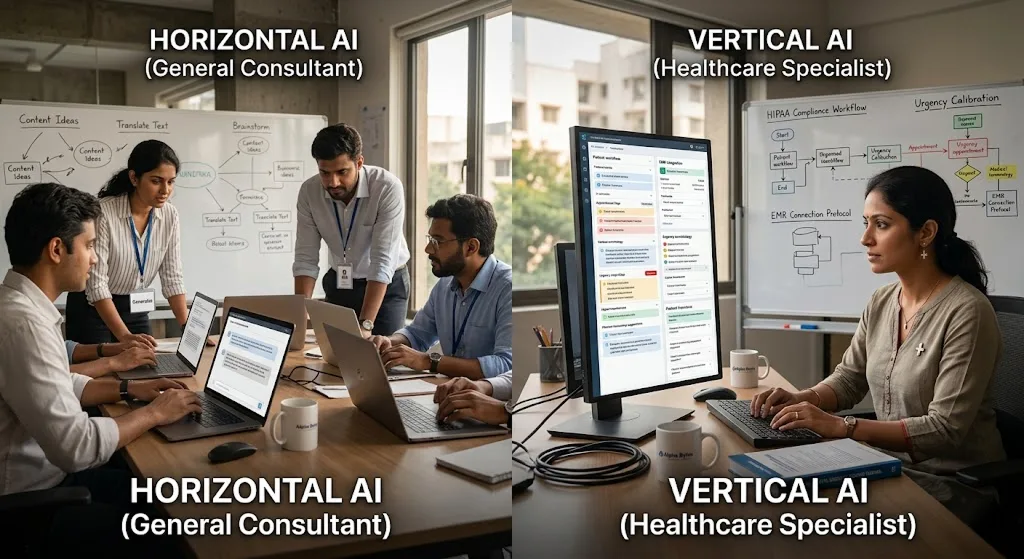
A healthcare clinic in Bangalore had been using ChatGPT to help with patient communication and appointment scheduling. It worked partially. The responses were grammatically clean but medically vague, and the AI had no concept of appointment urgency, insurance terms, or the specific workflows their practice used. Then they switched to a vertical AI tool purpose-built for healthcare clinics. The difference was immediate. The new system understood medical terminology, flagged high-priority appointments, integrated with their EMR software, and generated responses compliant with healthcare communication standards. The generic tool gave them AI. The vertical tool gave them an AI that understood their business.
That's the core of what vertical AI is and why it's become the most important shift in how businesses use artificial intelligence in 2026. Vertical AI refers to AI systems built specifically for a single industry or professional domain, trained on that industry's data, optimized for its workflows, and governed by its specific compliance requirements. Unlike horizontal AI tools like ChatGPT or Claude which are general-purpose and serve every industry vertical AI goes deep instead of wide. In this guide, we cover exactly what vertical AI is, how it differs from generic AI tools, why it's replacing them across six major industries, and how small businesses can start using it today.
What Is Vertical AI? The Exact Definition
Vertical AI is artificial intelligence specifically designed, trained, and optimized for a single industry or professional domain. It uses data, terminology, workflows, and compliance frameworks unique to that sector rather than the broad, general-purpose training of tools like ChatGPT, Gemini, or Claude.
Vertical AI refers to artificial intelligence technologies specifically designed for and tailored to particular industries or sectors. Unlike horizontal AI, which offers general-purpose solutions applicable across various fields, vertical AI focuses on addressing the unique challenges and needs of specific vertical markets. This specialization enables more precise and effective solutions, deeply integrated into the particular operational, regulatory, and data contexts of an industry.
The Vertical vs Horizontal Distinction Why It Matters
Think of it this way. A horizontal AI tool is like a brilliant generalist consultant smart, articulate, and useful across dozens of domains. A vertical AI tool is like a specialist who has spent twenty years inside your specific industry. The generalist can help you draft a legal contract. The specialist knows exactly which clauses to include for your jurisdiction, which regulatory requirements apply to your sector, which standard template your counterpart's legal team will expect, and what language courts in your region have consistently upheld.
The difference in output quality for domain-specific tasks is significant and measurable. Vertical AI models reduce error rates by 20–40% compared to generic models across many sectors, and over 70% of enterprises require AI outputs to comply with domain-specific rules and regulations whether that's healthcare codes, financial controls, or manufacturing standards. Generic AI cannot reliably deliver this level of domain accuracy regardless of how well it is prompted.
What Makes an AI "Vertical"?
Four specific characteristics define a vertical AI system:
- Domain-specific training data: trained on datasets from the target industry (medical records, legal documents, financial reports, e-commerce catalogues) rather than the general web
- Industry vocabulary and context: understands sector-specific terminology, acronyms, product names, and regulatory language as native knowledge rather than inferences
- Compliance-aware architecture: built with the regulatory requirements of the industry in mind HIPAA for healthcare, PCI-DSS for payments, GDPR for data handling
- Workflow integration: designed to connect directly with the specific software systems the industry uses (EMR, ERP, CRM, POS, legal case management) rather than requiring custom API work for every connection
Vertical AI vs Horizontal AI: The Complete Comparison
Understanding the difference between vertical and horizontal AI is the foundation for making the right tool decision for your business. Here's the honest comparison across every dimension that matters.
Accuracy for Industry-Specific Tasks
Horizontal AI (ChatGPT, Claude, Gemini): Excellent for general writing, research, and reasoning. Accuracy degrades on highly specialized tasks where domain knowledge matters medical diagnosis framing, legal jurisdiction specifics, financial compliance checking, manufacturing quality standards.
Vertical AI: Trained specifically on domain data, so accuracy on industry-specific tasks is significantly higher. As Jake Heller, CEO of CaseText (acquired by Thomson Reuters for $650 million), said: "To automate mission-critical tasks, general-purpose AI isn't enough you need domain-specific integration, precision, and accuracy at nearly 100%."
Setup Time and Ease of Use
Horizontal AI: Near-zero setup. Sign up, start prompting. The flexibility is real you can use it for any task immediately without configuration.
Vertical AI: Requires initial configuration and integration with your specific workflows. This setup investment pays off quickly through better outputs and lower error rates but it's not instant-on the way a ChatGPT subscription is.
Cost
Horizontal AI: $0–$200/month for individual users. Very low cost of entry. Cost scales predictably with usage.
Vertical AI: Higher initial investment typically $500–$5,000+/month depending on the platform and industry. Often includes implementation support, compliance features, and integration work that generic tools don't provide.
Compliance and Regulation
Horizontal AI: Not inherently compliant with industry regulations. Using ChatGPT to process patient data, financial records, or legal documents creates compliance liability that the user, not OpenAI, is responsible for managing.
Vertical AI: Built with compliance at the architectural level. Healthcare vertical AI is HIPAA-compliant by design. Legal vertical AI is designed for attorney-client confidentiality. Financial vertical AI is built around AML and fraud detection requirements. This is not an add-on it is the foundation.
Integration With Existing Business Systems
Horizontal AI: Requires custom API work to connect to your specific CRM, ERP, or practice management software. Every integration is a separate development project.
Vertical AI: Pre-built integrations with the dominant software platforms in each industry. A healthcare vertical AI connects natively to Epic, Cerner, or Athenahealth. A legal vertical AI integrates with Clio or PracticePanther. An e-commerce vertical AI connects to Shopify, WooCommerce, or Magento. The connectors already exist.
Why Vertical AI Is Replacing Generic Tools in 2026 The Numbers
This shift from generic to industry-specific AI isn't theoretical. The market data from 2026 confirms it's already happening at scale.
The Market Has Crossed a Critical Threshold
The global vertical AI market size was estimated at $10.3 billion in 2025 and is expected to reach $13 billion in 2026 growing at a CAGR of 28.3% through 2033 to reach $74.5 billion. This isn't incremental growth this is the fastest-growing segment of the entire technology market.
PitchBook reported that vertical AI applications led all AI deal volume with 663 transactions in Q3 2025 alone more deals in a single quarter than most technology categories see in a year. Enterprise generative AI spend reached $37 billion in 2025, with industry-specific AI solutions attracting approximately $3.5 billion of that total.
Enterprise Adoption Is Near-Universal
Gartner predicts that by 2026, 80% of enterprises will have adopted vertical AI agents a figure that would have seemed implausible two years ago and now looks conservative given current adoption curves.
Bessemer Venture Partners frames the business model shift clearly: "Vertical AI isn't competing for IT budgets it's competing for labour budgets. Unlike vertical SaaS, which typically captures a fraction of Fortune 500 IT spend, Vertical AI taps directly into the labour line of a P&L." When you understand this framing, the adoption speed makes sense. Businesses aren't buying software they're replacing expensive human labor with specialized AI that does the same work with higher accuracy, around the clock.
The Generic AI Ceiling Is Real
Generic models are no longer sufficient for enterprise needs. In 2026, AI adoption is increasingly shifting toward industry-specific, domain-trained systems especially in regulated, high-stakes environments such as healthcare, finance, and manufacturing. Vertical AI delivers higher accuracy, better compliance, and deeper context, enabling AI to understand industry rules, terminology, and workflows rather than relying solely on general knowledge.
The practical experience matches the data. Businesses that deploy ChatGPT or Claude for industry-specific workflows almost universally hit the same ceiling: the outputs are good but not reliable enough for mission-critical tasks without extensive human review. Vertical AI closes that gap because it was trained for the specific task from the beginning.
Vertical AI Examples Across 6 Industries in 2026
The strongest evidence for vertical AI's impact is in the specific, concrete results across industries. Here are six real examples of what industry-specific AI is doing right now.
1. Healthcare: Transforming Clinical Documentation
Healthcare is the strongest vertical AI signal by far. US healthcare AI spending reached $1.4 billion in 2025, with 22% of healthcare organizations having implemented domain-specific AI tools the highest implementation rate of any industry vertical.
The primary use cases are clinical documentation and patient communication. AI tools like Nuance DAX (Microsoft), Abridge, and Suki record physician-patient conversations and automatically generate clinical notes that match the physician's documentation style, integrate with the EMR system, and use medically accurate terminology. The time saved typically 2–3 hours per physician per day translates directly into more patient appointments and reduced burnout.
For small healthcare businesses clinics, dental practices, physiotherapy centers, specialist consultants vertical AI tools handle appointment scheduling, insurance pre-authorization workflows, patient follow-up communication, and billing reconciliation with a level of accuracy and compliance that ChatGPT simply cannot provide.
2. Legal: Automating Document Review and Research
Global legal tech funding reached $5.99 billion across 292 companies in 2025, with 14 rounds of $100 million or more confirming the legal vertical as one of the most heavily capitalized AI deployment areas globally.
Legal vertical AI tools like Harvey (backed by Sequoia), Casetext, and Ironclad handle contract analysis, due diligence review, legal research, and document drafting at a level that general AI cannot match. They understand jurisdiction-specific case law, precedent structures, and contractual standards that a horizontal AI would have to be taught with extensive prompting and still might get wrong. For small law firms and solo practitioners, these tools are closing the gap between boutique practices and large firm resources.
3. E-Commerce: Personalization at Scale
58% of retail and CPG organizations were actively deploying AI in 2026 up from 42% the year before making e-commerce the fastest-growing vertical AI adoption area.
Vertical AI for e-commerce personalizes product recommendations, automates pricing adjustments based on demand signals, generates product descriptions tailored to different customer segments, and handles post-purchase customer service with full order context. Tools built specifically for Shopify, WooCommerce, and Magento understand the platform's data structures natively meaning they can take action, not just generate text responses.
For small e-commerce businesses, this means a solo operator can run a personalized shopping experience that previously required a data science team increasing conversion rates, average order value, and customer retention simultaneously.
4. Financial Services: Fraud Detection and Compliance
77% of banks surveyed by EY-Parthenon had launched or soft-launched generative AI applications in 2025, up from 61% in 2023 and the primary application is compliance and fraud detection, where the cost of errors is existential rather than just operational.
Fintech vertical AI tools analyze transaction patterns, flag anomalies against industry-specific fraud signatures, generate regulatory reports in formats required by specific jurisdictions, and maintain audit trails that generic AI outputs cannot reliably produce. For small financial businesses accounting firms, insurance brokers, mortgage advisors vertical AI handles compliance documentation that currently requires expensive specialist consultants.
5. Construction and Trades: The Least Digitised Industry Going AI-First
The US construction and home services market is valued at approximately $2.2 trillion annually, yet field technicians currently spend 30% of their working hours on administrative tasks documentation, permit filings, and job briefs. That administrative load exceeds the 28% they spend actually performing core services. Vertical AI automating this administrative tax provides immediate, quantifiable ROI for small contractors.
AI tools built specifically for HVAC technicians, plumbers, electricians, and contractors are generating job estimates, managing scheduling, filing permit applications, and creating compliance documentation all tasks that previously required a back-office administrator.
6. E-Learning and Education: Personalized Curriculum at Individual Level
Education vertical AI adapts learning content to individual student progress, generates assessments calibrated to specific curriculum standards, and provides tutoring responses grounded in educational psychology frameworks rather than general knowledge. Tools built for specific subjects or age groups outperform general-purpose AI tutors because they understand the cognitive scaffolding required at each learning level not just the subject matter.
Vertical AI for Small Business: How to Actually Get Started
The vertical AI opportunity isn't reserved for enterprises. Small businesses are often better positioned to adopt vertical AI quickly precisely because they don't have legacy systems and change management bureaucracy slowing them down.
Step 1: Identify Your Industry's Highest-Pain Workflow
The vertical AI tools with the best adoption rates solve the same type of problem across the businesses in their industry: the high-frequency, domain-specific task that requires accuracy but consumes disproportionate time. For a clinic, it's documentation. For a law firm, it's contract review. For a retailer, it's inventory and personalization. For a contractor, it's estimates and scheduling. Identify yours before evaluating tools.
Step 2: Audit the Vertical AI Tools Available in Your Sector
Every major industry now has at least 3–5 purpose-built AI tools competing for market share. Start with a direct search: "[your industry] AI tools 2026." Cross-reference against review platforms G2 for B2B software, Capterra for SMBs and look for tools that specifically mention your industry's compliance frameworks in their feature list.
Step 3: Run a 30-Day Pilot on One Workflow
Don't try to replace your entire tech stack with vertical AI at once. Choose the one workflow where accuracy matters most and current tools fail most often. Run the vertical AI tool on that workflow exclusively for 30 days. Measure error rate, time saved, and staff satisfaction. Use that data to build the business case for broader deployment.
Step 4: Integrate With Your Existing Systems Before Scaling
The power of vertical AI compounds when it's connected to your existing business data your CRM, your ERP, your booking system. Most vertical AI tools have pre-built integrations with the dominant platforms in their industry. Verify these integrations work correctly in your specific setup before committing to full deployment.
What Alpha Bytes Builds for Vertical AI Clients
At Alpha Bytes, we build the web platforms and AI integration systems that connect vertical AI tools to the rest of a business's digital infrastructure. For healthcare clients, we build patient-facing platforms that integrate with clinical AI tools at the backend. For e-commerce clients, we build custom storefronts with AI personalization engines wired directly into the product catalogue and order management system. The vertical AI tool provides the domain intelligence we provide the architecture that makes it accessible to the customer and connected to the business.
The competitive advantage of vertical AI for small businesses isn't just better outputs it's the ability to operate at a standard of accuracy and compliance that previously required expensive specialists or large teams. A two-person clinic using healthcare vertical AI can document and communicate at the standard of a large hospital system. A solo contractor using trades AI can generate estimates and manage compliance at the standard of a 50-person operation. That gap-closing is what Bessemer calls competing for the labour budget and it's available to every business willing to make the initial integration investment.
Is Vertical AI Worth It for Small Business? The Honest Answer
The upfront cost of vertical AI is real and it's higher than a $20/month ChatGPT subscription. For most small businesses, vertical AI tools start at $200–$500/month and scale with usage. The implementation and integration work adds to the initial investment.
The ROI case, however, is straightforward when the calculation is honest. If a healthcare vertical AI tool saves one physician two hours of documentation per day, and that physician's time is worth $150/hour, the tool saves $300/day or approximately $6,000/month. A $400/month subscription pays for itself within the first three days of the month.
The businesses that get the most from vertical AI are those with a clear, high-frequency, domain-specific workflow that currently requires significant human time to complete accurately. If that describes your business and in most industries it does vertical AI is not a nice-to-have. It is the most direct path to scaling your capacity without scaling your headcount.
Key Takeaways
Everything you need from this guide:
- Vertical AI is AI built specifically for one industry trained on domain-specific data, compliant with industry regulations, and integrated with the tools that industry uses
- The global vertical AI market is growing at 28.3% CAGR and was valued at $13 billion in 2026 the fastest-growing segment of the technology market
- Vertical AI reduces error rates by 20–40% compared to generic models on industry-specific tasks the accuracy gap is significant and measurable
- Gartner predicts 80% of enterprises will have adopted vertical AI agents by end of 2026
- The six strongest verticals right now: healthcare (documentation), legal (contract review), e-commerce (personalization), financial services (compliance), construction (administrative automation), and education (adaptive learning)
- For small businesses: identify your highest-pain domain-specific workflow, run a 30-day pilot on one vertical AI tool, measure the time saved, and scale from there
- Vertical AI isn't replacing generic AI tools entirely it's replacing them for the specific, high-stakes, domain-intensive tasks where generic accuracy is genuinely insufficient
Final Thoughts
The shift from generic to vertical AI isn't a trend it's the natural maturation of how AI tools get deployed in real businesses. Generic AI proved the concept. Vertical AI delivers the results. We are no longer just digitizing generic processes; we are reimagining the systems of work for specific industries. For small businesses, that reimagining is now accessible not just to enterprises with data science teams and seven-figure software budgets.
At Alpha Bytes, we build the platforms and integration systems that connect vertical AI intelligence to the rest of a business's digital operations whether that's a healthcare clinic needing a patient portal integrated with clinical AI, an e-commerce store needing a personalization engine wired to the product catalogue, or a professional services firm needing a client-facing system connected to industry-specific AI workflows. If you want to understand what vertical AI could look like for your specific industry and business, we'd love that conversation. Check out our related posts below, or reach out to the Alpha Bytes team directly.