 Dhaval G.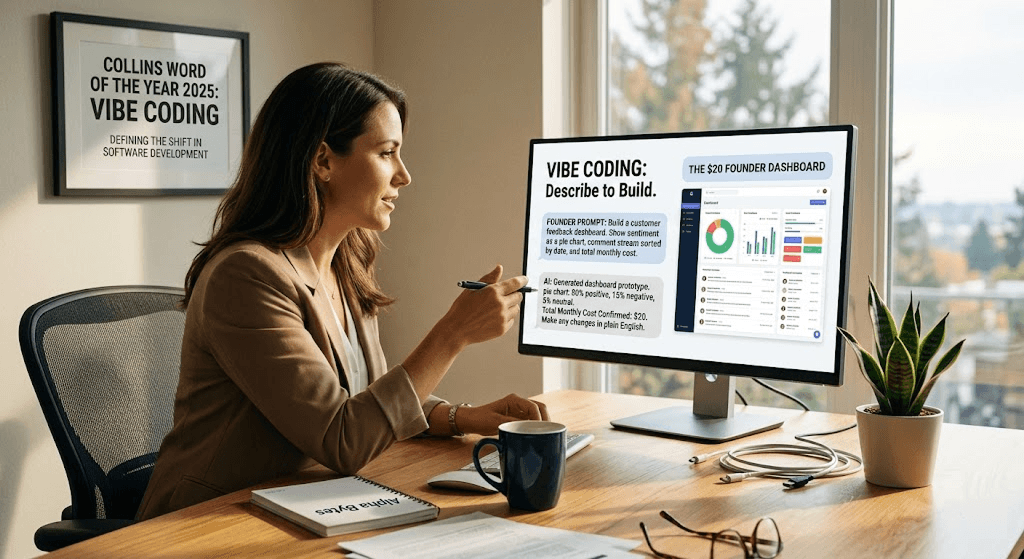
A founder we spoke with recently built a working customer feedback dashboard in a single afternoon. No developer hired. No Fiverr order placed. No months of waiting. She described what she wanted in plain English, an AI generated the code, and she kept refining it with more prompts until it did exactly what she needed. Total cost: a $20 monthly subscription to an AI coding tool.
That's vibe coding. And it's not a niche developer hobby anymore. Collins English Dictionary named "vibe coding" its Word of the Year for 2025 and in 2026, it's become one of the most searched terms in tech globally. Whether you're a startup founder, a business owner, or a developer trying to understand where the industry is heading, this guide covers everything you need to know: what vibe coding actually is, how it works, the best tools available right now, what it genuinely can and can't do, and whether it's something your business should be paying attention to.
What Is Vibe Coding, Exactly?
The term was coined by Andrej Karpathy former Director of AI at Tesla and founding member of OpenAI in February 2025. He described it as "fully giving in to the vibes, embracing exponentials, and forgetting that the code even exists." The idea spread instantly. Within weeks, it was being used to describe an entire shift in how software gets built.
At its core, vibe coding is this: instead of writing code line by line, you describe what you want to build in plain English and an AI generates the code for you. You then give feedback, refine, test, and repeat until the result matches your vision. This approach shifts the role of developers from "coding" to "directing." The name comes from the idea of working in a creative flow or vibe rather than focusing on rigid syntax you express intent in plain language, experiment quickly, and iterate based on feedback.
The Simplest Way to Think About It
Think of it like going from being a chef who cooks every dish from scratch to being an executive chef who tells the kitchen team what to make while they do the cooking. You're still responsible for the quality of the meal, the decisions, and the direction. You just don't have to chop every vegetable yourself.
For business owners, this is a significant shift. Things that previously required hiring a developer internal tools, custom dashboards, landing pages, data processing scripts, prototype apps are now buildable by someone with no coding background at all. Not perfectly, not for every use case, but for a growing number of real world needs: absolutely.
Why Is Vibe Coding Exploding in 2026?
The numbers are staggering, and they're worth understanding because they tell you how fast this is moving.
The Market Is Growing at an Unprecedented Rate
Vibe coding went from a meme to a $4.7 billion market in under 18 months. What started as Andrej Karpathy's tongue in cheek tweet about "fully giving in to the vibes" has become the fastest growing category in developer tools with a compound annual growth rate of 38%, and projections placing the market at $12.3 billion by 2027.
To put that in context: the entire no code/low code market took nearly a decade to reach that scale. Vibe coding got there in under two years.
Adoption Is Now Near Universal Among Developers
84% of developers use or plan to use AI coding tools, up from 76% in 2024. Among professional developers, 50.6% use AI tools daily and 17.7% weekly. In the United States specifically, 92% of developers use AI coding tools daily.
This is not a fringe movement. It's the mainstream. The developers your business hires, the agencies you work with, the tools your technical team relies on they're almost certainly already building with AI-assisted workflows, whether they call it "vibe coding" or not.
Big Tech Is All In
This isn't just happening at startups. At Google and Microsoft, 30% of new code is now AI generated, demonstrating these tools have moved beyond experimentation to become core infrastructure. GitHub Copilot has 4.7 million paid subscribers, Cursor surpassed $2 billion ARR in February 2026, and Lovable reached $400 million ARR in the same month.
Gartner projects that 60% of all new code will be AI generated by the end of 2026. That number would have seemed absurd 18 months ago. Today it feels almost conservative.
How Does Vibe Coding Actually Work? (Step by Step)
You don't need to be technical to understand the process. Here's how a typical vibe coding session unfolds in practice:
- Describe your idea in plain English. You open a vibe coding tool Cursor, Lovable, Bolt.new, or similar and type out what you want to build. "Build me a form that collects customer feedback, saves it to a database, and sends me an email notification when someone submits." That's it. No code written yet.
- The AI generates the code. The AI reads your prompt, reasons through the requirements, and produces working code often hundreds of lines of it in seconds. It selects frameworks, handles technical dependencies, and makes implementation choices you never had to specify.
- You run it and test it. The platform previews or runs the result. You check if it does what you described. Usually, first attempts are close but not perfect.
- You refine through more prompts. "Make the button blue. Add a character limit to the feedback field. Remove the phone number field." Each prompt refines the output. You're iterating in conversation, not debugging code.
- You deploy it. Most vibe coding platforms handle hosting and deployment. You copy a link and share it. Done.
The entire cycle from idea to working product can happen in hours rather than weeks. For prototypes, internal tools, and simple applications, this is genuinely transformative.
The Best Vibe Coding Tools in 2026
The tooling landscape has matured fast. Here's what's actually worth your attention:
For Non Developers and Founders
- Lovable: The breakout platform of 2025. It hit $100 million in ARR in just 8 months one of the fastest growing startups on record and is now valued at $6.6 billion. You type what you want in plain English and get a full stack web app. Ideal for founders building their first product.
- Bolt.new: Known for rapid, single prompt app generation. Best for quick prototypes and first drafts when you want results in minutes, not hours.
- v0 by Vercel: Frontend focused, gaining significant traction in 2026 for UI generation specifically. If you need a polished interface designed quickly, this is the tool.
- Google Firebase Studio: Google's entry into the space. Lets you describe and deploy apps with zero coding experience required.
For Developers and Technical Teams
- Cursor: The dominant professional grade vibe coding tool. A full IDE with deep AI integration, context awareness, and codebase understanding. GitHub Copilot is the most widely deployed AI coding tool in enterprise environments globally, now generating over $2 billion in ARR.
- GitHub Copilot: The most established option, deeply integrated into VS Code and major IDEs. Best for developers who want AI assistance inside their existing workflow rather than a fresh platform.
- Claude Code: Anthropic's terminal based agentic coding tool. Exceptionally strong for complex, multi file tasks and for developers who want an agent that understands the full context of a codebase.
- Windsurf: Emerging as a strong Cursor alternative for high stakes engineering work requiring more control.
Who's Already Using This?
87% of Fortune 500 companies have adopted at least one vibe coding platform. 21% of Y Combinator Winter 2025 startups have codebases that are 91% AI generated. If you're thinking this is still early adopter territory it's not. The enterprise world is already fully on board.
What Can Vibe Coding Actually Build? Real Use Cases
This is the section most people skip to and understandably. Let's be concrete.
What Vibe Coding Is Great At
- Internal tools: Custom dashboards, admin panels, data entry forms, inventory trackers, reporting tools. These are the highest ROI use cases because the alternatives (hiring a developer or buying a bloated SaaS product) are expensive.
- Landing pages and marketing sites: Simple, single purpose pages for campaigns, product launches, and lead generation.
- Prototypes and MVPs: Getting a working version of a product idea in front of users or investors in days, not months.
- Data processing scripts: Automating repetitive tasks like reformatting spreadsheets, sending batch emails, or generating reports from raw data.
- Simple customer facing apps: Feedback forms, booking flows, basic calculators, pricing tools.
What Vibe Coding Still Struggles With
Honesty matters here and this is where a lot of the breathless coverage falls short.
- Complex, scaled production systems Apps with thousands of concurrent users, complex data relationships, real time requirements, or enterprise security standards still require experienced developers to architect properly.
- Maintenance of AI generated code An indie developer built an entire SaaS product with Cursor with zero hand written code. It worked. Users signed up. Within weeks, random things were happening, API keys were being maxed out, and people were bypassing the subscription. He couldn't debug it he didn't write it. The product was shut down permanently. This isn't an isolated case.
- Security sensitive applications Healthcare platforms, financial systems, and legal tools require audit trails, compliance controls, and security architecture that AI code generation currently can't fully guarantee.
- Long term ownership When the person who "vibe coded" something leaves, and no one else can understand what was built or why, you have a serious maintainability problem.
Our take at Alpha Bytes: vibe coding is a powerful prototyping and internal tooling layer, not a replacement for thoughtful engineering. The best teams we've seen use vibe coding to move fast in the early stages, then bring proper developers in to harden what's worth keeping. Speed at the start, rigour at the finish line.
The Real Risks of Vibe Coding (And How to Avoid Them)
Vibe coding doesn't break security controls it stress tests them. By lowering the cost of producing code, AI dramatically increases the volume and speed of software change. When review, ownership, and accountability don't scale at the same pace, teams lose control over what is being shipped.
The Trust Paradox
Here's the counterintuitive finding that surprised us: developer trust in AI code is falling fast, dropping from around 40% to 29% in a single year. Distrust now outweighs trust among developers, with 46% actively distrusting AI tools versus 33% who trust them. Yet 96% don't fully trust that AI generated code is functionally correct while only 48% always review it before pushing to production.
Developers are using tools they don't fully trust, on code they don't always review. That gap between adoption and scrutiny is where real production problems live.
Three Rules for Safe Vibe Coding
- Never push AI generated code to production without review. Even if it looks right. Especially if it looks right. AI generates plausible looking code that can contain logic errors, hardcoded credentials, or disabled security checks that won't appear until something breaks.
- Start with a human in the loop. Use vibe coding to generate a draft, then have someone who understands the codebase review it before deployment. The speed advantage is still enormous even with this step.
- Don't vibe code security critical paths. Authentication, payment handling, data encryption, user permissions these are areas where AI assistance should be minimal and human oversight should be absolute.
What Does Vibe Coding Mean for Your Business Specifically?
If you're a business owner or startup founder, here's the practical implication that matters most: the cost of building custom software just dropped significantly. Not to zero but enough to change your calculus on what's worth building.
Things that weren't worth commissioning a developer for a custom internal reporting tool, a client facing calculator, a simple onboarding flow are now buildable in hours at minimal cost. That means more experimentation, faster feedback loops, and better tools for your team without the 6 week development queue.
For businesses working with agencies like Alpha Bytes, the workflow is changing too. We use vibe coding tools to prototype faster, show clients working mockups instead of static wireframes, and reduce the back and forth on what something should look and feel like. The result is faster delivery and less guesswork both for us and for our clients.
The SaaS pocalypse of February 2026 wiped $285 billion from SaaS company valuations in a single month. The thesis was straightforward: if non developers can build custom software in minutes through natural language prompts, why would they pay $50–200 per seat per month for rigid off the shelf SaaS products? The businesses that understand this shift and act on it will have a measurable advantage over those still buying one size fits all software.
Key Takeaways
Here's the full picture in five bullets:
- Vibe coding means building software by describing what you want in plain English the AI writes the code, you direct the outcome
- It went from a coined phrase in February 2025 to a $4.7 billion global market by early 2026, growing at 38% annually
- 92% of US developers use AI coding tools daily; Gartner predicts 60% of all new code will be AI generated by end of 2026
- The best use cases are internal tools, prototypes, landing pages, and simple apps not complex, security critical production systems
- The risk isn't the technology itself it's speed without scrutiny. Always review AI generated code before deploying to production
Final Thoughts
Vibe coding isn't replacing software development. It's replacing the parts of software development that never needed to be as slow and expensive as they were the prototyping, the internal tooling, the simple apps that sat in a backlog for six months because no developer had bandwidth. That liberation of time and capability is genuinely significant, and it's available right now.
The businesses that thrive in the next two years won't be the ones that resist this shift or blindly embrace it. They'll be the ones that understand where AI generated code is appropriate, where human expertise is non negotiable, and how to combine both intelligently. At Alpha Bytes, that's exactly how we're building and how we're helping our clients build. If you want to explore what vibe coding and AI development could look like for your specific project, we're happy to have that conversation. Check out our related posts below, or reach out to the team directly.